Those of you who are my longtime readers (what few of you may be left...) know that one of my perpetual bugbears (as opposed to actual bugbears, of which I am quite fond) has been the archetype and role of the cleric in a setting. And while I'm not alone in this, it's always nice to get a little reminder that others think about it a lot too, as Anders has over at Mythlands-Erce. Go give his post some love.
I'm still not quite up to blogging regularly, but I do have some things that, I hope, will be ready for primetime that I can share soon. Maybe that will be the start I need for further work in the near future.
Showing posts with label musings. Show all posts
Showing posts with label musings. Show all posts
Saturday, May 14, 2016

Wednesday, December 17, 2014
Seven Cosmic Rumors
Might as well try to write something.
- Illithids once had an empire that spanned worlds. Why have they degenerated and devolved into a handful of enclaves deep within the earth? Because the dead god on which the Githyanki built their astral capital is Ilsensine, their patron. What the Githyanki don't know is that sooner or later Ilsensine is going to stop playing possum.
- It's easier to get to the Astral Plane from the elemental planes of water and air than the planes of fire and earth. Water and Air elementals are known to brag about this in mixed company.
- It's said that there's one location in the world that is a natural gate to each outer plane. Mount Celestia is a particularly tall mountain range on which an order of Lawful Good monks live forever in pursuit of spiritual alignment, the Abyss is a massive gorge shrouded in scalding-hot steam and noxious vapors, Mechanus is an elaborate space station that has sat in orbit since time beyond memory, and so on and so forth. Regardless, all are hopelessly remote and it would be a fool's errand to try to journey to them... unless one were a great hero.
- The best way to get to the Moon is by ethereal travel. Somehow it manages to be the one part of the Ethereal that's really scenic. The moon itself is ethereal stone and exists equally in both planes.
- Ilepho, a gnome philosopher, once wrote that the Feywild and the Shadowfell are not separate planes unto themselves, but that the material plane, like many outer planes, has overlapping layers (if you must know, he compared it to a Spanakopita). His half-sister Argia the Elder disagreed, she wrote that the Feywild is the ancient, mythic past and the Shadowfell is the aftermath of some future catastrophe yet to be seen. Their disagreement culminated into a duel to the death.
- The stars are roughly divided (in increasing order of frequency) between being the distant suns of other worlds, holes in the dome of the sky through which the radiance of distant planes leaks, the eyes of unfathomable entities that coolly and enviously regard the earth, and ordinary rocks with Continual Light spells cast upon them that slipped the surly bonds of earth to float in the sky. Depending on who you ask, this list might be in a different order.
- There used to be other elemental planes. No one has seen them in centuries.
Saturday, September 14, 2013
On my problem with Demons and Devils
Jeeeeezis, has it been two weeks already? Sorry, guys, real life has been eating me alive. But there is some good news, I have plans to set up an LGBTQI and allied women's West Marches game! Neat, huh? But that's not what this post is about. Though if it gets off the ground I will post about it, I assure you.
So here's what this post is actually about: For a while now I haven't liked most D&D Demons or Devils and I never was able to put a finger on why. Until tonight. Tonight I realized that the ones that I like the best (Balors, Succubi, and Imps/Quasits, and to a lesser extent Malebranche/Cornugon and Abishai-- Abishai in particular, as they were illustrated in 3.5, are in my opinion particularly attractive) all have something in common. Or rather, that the ones I don't like all have something in common. Iconicness. Those three demons are all very recognizable, very easy to grok. And for me that's an important part of D&D's specialness-- it's built on images that just about anyone who's read a few fairy tales or mythology books or been to the movies in their lives understands well enough that they can follow along and work with. Even many of its monsters, I think, are easy to make sense of. A mind-flayer is a tentacle alien that eats brains. A carrion crawler is a big scavenger worm. An owlbear is exactly what the name suggests it would be. A Bulette is a land shark, literally. A rust monster is a silly looking animal that makes metal rust.
But so many of D&D's fiends feel like... well, strange hodgepodges of thrown-together animal parts with a random assortment of magical spells. If I say "devil" or "demon" your brain probably doesn't leap to "insect person with ice powers" or "four-armed dog-gorilla with lobster claws", it's probably more like one of these bastards: exaggerated, funny-colored humans with goat horns and bat wings and tails with a little arrowhead thingy on them and fangs, and perhaps cloven hooves, conjuring up fire and darkness and either here to kick some unholy ass or buy your soul for wealth, power, or wishes, but either way here to make sure somebody goes to hell; the stuff of heavy metal album covers.
The weird thing is that most of the highest ranks of D&D's demons and devils look like this. Asmodeus, Orcus, Grazz't, they all look like devils and demons. But their underlings just don't click for me.
Of course I like the occasional possessor too. D&D never really had that, as far as I know, the closest it ever got was the Shadow Demon, which isn't too awful either, but even that only sort of felt like it was the thing.
So here's how it'll be. My next several posts, I'll give you some demons I might use. I'm not saying they're original. I'm not saying they're clever. I'm definitely not saying they're gonzo, they're about as far from that as you get. But if you want them, you'll have them.
So here's what this post is actually about: For a while now I haven't liked most D&D Demons or Devils and I never was able to put a finger on why. Until tonight. Tonight I realized that the ones that I like the best (Balors, Succubi, and Imps/Quasits, and to a lesser extent Malebranche/Cornugon and Abishai-- Abishai in particular, as they were illustrated in 3.5, are in my opinion particularly attractive) all have something in common. Or rather, that the ones I don't like all have something in common. Iconicness. Those three demons are all very recognizable, very easy to grok. And for me that's an important part of D&D's specialness-- it's built on images that just about anyone who's read a few fairy tales or mythology books or been to the movies in their lives understands well enough that they can follow along and work with. Even many of its monsters, I think, are easy to make sense of. A mind-flayer is a tentacle alien that eats brains. A carrion crawler is a big scavenger worm. An owlbear is exactly what the name suggests it would be. A Bulette is a land shark, literally. A rust monster is a silly looking animal that makes metal rust.
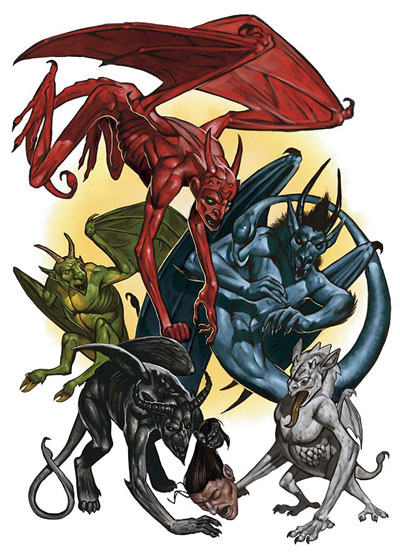
But so many of D&D's fiends feel like... well, strange hodgepodges of thrown-together animal parts with a random assortment of magical spells. If I say "devil" or "demon" your brain probably doesn't leap to "insect person with ice powers" or "four-armed dog-gorilla with lobster claws", it's probably more like one of these bastards: exaggerated, funny-colored humans with goat horns and bat wings and tails with a little arrowhead thingy on them and fangs, and perhaps cloven hooves, conjuring up fire and darkness and either here to kick some unholy ass or buy your soul for wealth, power, or wishes, but either way here to make sure somebody goes to hell; the stuff of heavy metal album covers.


The weird thing is that most of the highest ranks of D&D's demons and devils look like this. Asmodeus, Orcus, Grazz't, they all look like devils and demons. But their underlings just don't click for me.
Of course I like the occasional possessor too. D&D never really had that, as far as I know, the closest it ever got was the Shadow Demon, which isn't too awful either, but even that only sort of felt like it was the thing.
So here's how it'll be. My next several posts, I'll give you some demons I might use. I'm not saying they're original. I'm not saying they're clever. I'm definitely not saying they're gonzo, they're about as far from that as you get. But if you want them, you'll have them.
Monday, August 19, 2013
Why is it I want a feat or proficiency system so much?
Why?
Is it that I want to have a way to mechanically differentiate two PCs of the same class?
Is it just that I was that impressed with ACKS's handling of familiars?
I kind of wish I could just let it go because it causes me more angst than I'd quite like.
Is it that I want to have a way to mechanically differentiate two PCs of the same class?
Is it just that I was that impressed with ACKS's handling of familiars?
I kind of wish I could just let it go because it causes me more angst than I'd quite like.
Sunday, August 4, 2013
You know what?
I'm not really old school.
I just have a limited tolerance for complexity, especially in making characters.
I just have a limited tolerance for complexity, especially in making characters.
Sunday, July 28, 2013
Why do I like ACKS?
I don't hate domain play, but it's not my focus by a long shot. And let's not kid ourselves ACKS's forte is in domain play. Its AC system is... decidedly wonky. I've gotten used to it, but it took some doing. I don't care at all about realistic simulation-- for god's sake my second favorite edition of D&D is 4e (and 3.5 remains my least favorite)!
So what is it? What draws me to ACKS?
Is it the little tweaks? Things like the system of cleaving present in it, or the mage's repertoire and magical research stuff, the hijinks, the d20-based thief skills, or the list of poisons in the GM chapter? Is it Domains of War (which I've only got the free version of), which makes for a fun, effective battle minigame with more for tactics than the BECMI War Machine?
Partly, yeah.
Is it the proficiencies system, which does one of the best jobs of scratching the itch for feats and skills that my WOTC days imbued in me?
That's definitely a factor.
But I think I know what the number one reason is.
It's the classes. I'm absolutely a class slut. The more the merrier, in my book. And ACKS, between itself and the Player's companion, contains pretty much all my favorites. It has my favorite OSR ranger, my favorite bard anywhere, and a solid assassin, and that's just in the core book. The only one missing is the Warlord, and between the proficiencies available to the fighter and Thomas Weigel's excellent Aristocrat class, I'm more than taken care of. And should the mood strike me for a class that isn't already around, the Player's Companion explained the Autarchs' math well enough that it's the work of half an hour to bring my new class into the world. Ultimately that's the biggest factor in my choice.
So what is it? What draws me to ACKS?
Is it the little tweaks? Things like the system of cleaving present in it, or the mage's repertoire and magical research stuff, the hijinks, the d20-based thief skills, or the list of poisons in the GM chapter? Is it Domains of War (which I've only got the free version of), which makes for a fun, effective battle minigame with more for tactics than the BECMI War Machine?
Partly, yeah.
Is it the proficiencies system, which does one of the best jobs of scratching the itch for feats and skills that my WOTC days imbued in me?
That's definitely a factor.
But I think I know what the number one reason is.
It's the classes. I'm absolutely a class slut. The more the merrier, in my book. And ACKS, between itself and the Player's companion, contains pretty much all my favorites. It has my favorite OSR ranger, my favorite bard anywhere, and a solid assassin, and that's just in the core book. The only one missing is the Warlord, and between the proficiencies available to the fighter and Thomas Weigel's excellent Aristocrat class, I'm more than taken care of. And should the mood strike me for a class that isn't already around, the Player's Companion explained the Autarchs' math well enough that it's the work of half an hour to bring my new class into the world. Ultimately that's the biggest factor in my choice.
Saturday, July 20, 2013
What are Humanoids, anyway?
Over at his blog Beedo posted some rather clever alternative origins for humanoid monsters, to be used in a summer campaign for his children. It was a pretty interesting post and got me thinking about things. The origin I've used for most humanoids lately comes from half-remembered snippets of Norse mythology and from a somewhat slanted interpretation of describing the enemies that Dwarves and Rangers in AD&D 1e get special bonuses against as "giant class humanoids". My idea is that the "giant" in "giant class" doesn't (obviously) mean "huge", but perhaps means "man-like creations of primordial creatures that oppose the gods".
All well and good, but that leaves a few other humanoids unexplained: Lizardmen, Serpentmen (such as D&D's Yuan-ti), Frogmen (such as D&D's Bullywugs), and Troglodytes. Those all share the interesting quality of being amphibian or reptilian. Perhaps that implies a connection? A third set of creators? That might deserve some exploration of its own...
All well and good, but that leaves a few other humanoids unexplained: Lizardmen, Serpentmen (such as D&D's Yuan-ti), Frogmen (such as D&D's Bullywugs), and Troglodytes. Those all share the interesting quality of being amphibian or reptilian. Perhaps that implies a connection? A third set of creators? That might deserve some exploration of its own...
Saturday, July 13, 2013
Nostalgia for 3.5
...Dang, never thought that's something I'd have.
I dunno if it was just my age, or the fact that D&D was new to me in those days, or they just had a particularly engaging style, or what, but D&D 3.5 and its sourcebooks were just a great pleasure for me to read, once upon a time. Sometimes 4e reached those heights too. As strange as it may sound, 1e and 2e were never quite as enjoyable to me, nor even my beloved retroclones. B/X is okay reading, I guess, but a little light. If you haven't noticed I don't really care that much about other games besides D&D and its variants these days, though I am nominally in a Shadowrun game with my brother.
I dunno if it was just my age, or the fact that D&D was new to me in those days, or they just had a particularly engaging style, or what, but D&D 3.5 and its sourcebooks were just a great pleasure for me to read, once upon a time. Sometimes 4e reached those heights too. As strange as it may sound, 1e and 2e were never quite as enjoyable to me, nor even my beloved retroclones. B/X is okay reading, I guess, but a little light. If you haven't noticed I don't really care that much about other games besides D&D and its variants these days, though I am nominally in a Shadowrun game with my brother.
Tuesday, May 7, 2013
Would it ruin my old school cred...
If I said I just don't enjoy making dungeon mapping a fixture of the games I run?
My experience is that it tends to slow down play a bit more than I like because the player in charge of mapping wants to put everything on hold while she draws everything just to specifications?
There has to be a faster way short of just giving the players a copy of the dungeon map directly.
I realize nobody reads this blog, but if you are actually reading it I'd appreciate suggestions.
My experience is that it tends to slow down play a bit more than I like because the player in charge of mapping wants to put everything on hold while she draws everything just to specifications?
There has to be a faster way short of just giving the players a copy of the dungeon map directly.
I realize nobody reads this blog, but if you are actually reading it I'd appreciate suggestions.
Wednesday, April 24, 2013
Suspension of disbelief
If anyone's even out there... what typical elements of your game of choice do you have a hard time buying into?
Me, I'm a D&D girl, but... I just cannot into dungeons above a small "lair" size and population, unless they're so big as to be an environment unto themselves (like the Underdark). Those of us that have crossed paths with Mike Mornard have all heard the story of how he deflected the question of what the monsters in his dungeon eat by putting a McDonald's on the sixth level of it, but (as non-seriously as I normally take my gaming), even then I tend to fixate on how a handful of goblins are going to navigate through all the intervening hazards that presumably exist between his lair on the first level and Mickey D's on a regular basis.
Feel free to describe setting elements (from any game) that stick in your craw, or try to disabuse me of my notions, or whatever.
I don't want to set the world on fire
There are many things that fascinate me. Two of them in particular are the 1950s as perceived by America, both at the time and subsequently, and the prospect of nuclear war, perhaps because the Soviet Union fell when I was less than a year old and therefore its spectre never hung directly over me.
As you can imagine, I am thus greatly enamored of the Fallout series.
Last night, while watching a promotional video made by Redbook in 1957, I think I figured out exactly why, apart from the obvious fact that the bomb weighed heavily on many minds in the 1950s, that combination of 50s aesthetics and nuclear chaos have always captured my imagination so.
1) While I admire many of the aesthetics of the period, they are a thin veneer over a lot of simmering unpleasantness. I don't think the pretty stuff can be divorced from the hidden turmoil and hypocrisy that gave birth to it, so the only way to bring the two out of dissonance is to let the fire, the radiation, and the passage of time take a bat to it all.
2) I sometimes, in my more paranoid moments, think that humanity collectively cheated death in the cold war and worry that as the first generation after it came to an end, fear that it will be us that death ultimately somehow comes to collect on.
Subscribe to:
Posts (Atom)