Yeah, so I got a bunch of complaints about my old color scheme, and that was kind of upsetting me, so in a display of atypical levels of cowardice, I'm bowing to peer pressure and going monochrome.
Actually, I'm doing this because the complaints inspired me to at least give it a look and I found that I like it in monochromatic. I think it's gone from Victorian-antique pretty to gothic-lolita-outfit pretty. But either way, they can only have the pretty when they pry it from my cold dead hands.
Also, I made a house rule document for Basic Fantasy RPG, which for all my flirting with ACKS and FH&W recently, is still a damned solid game, and which I'm thinking I may use if I want to get a game moving in time for the 40th anniversary of D&D's publication (which, if Playing At The World is to be believed, is sometime in the last week of January!) Check it out here and criticize my pathetic leniency at your earliest convenience!
Showing posts with label BFRPG. Show all posts
Showing posts with label BFRPG. Show all posts
Saturday, January 18, 2014

Wednesday, December 11, 2013
New Monster: Diamond Dogs
Diamond Dogs
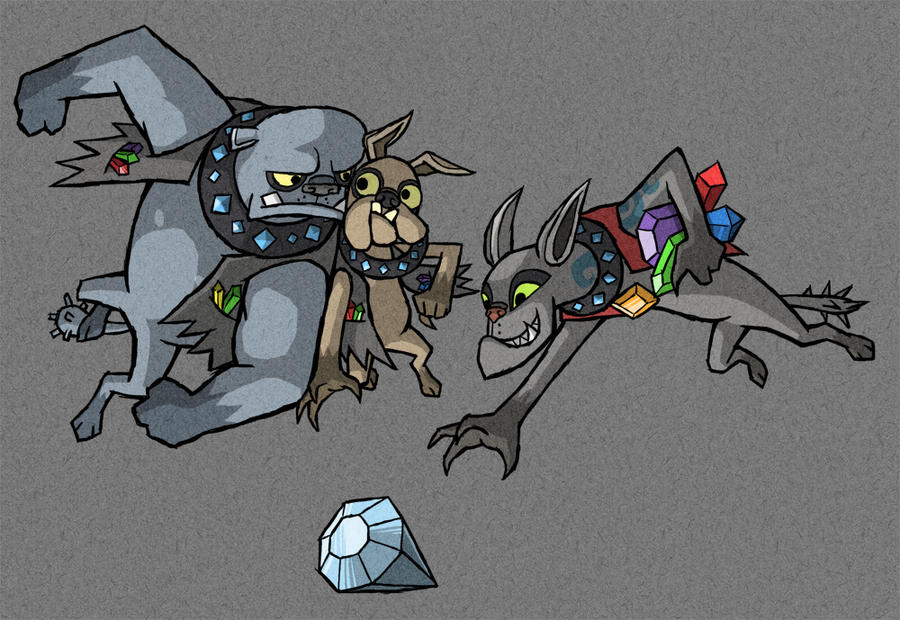 (Formatted for BFRPG, as usual)
Armor Class: 13
Hit Dice: 1*
Number of attacks: 1
Damage: 1d6 or by weapon
Movement: 40', burrow 20'
Number Appearing: 1d6, Wild 5d4, Lair 5d4
Save as: F1
Morale: 6
Treasure Type: D (additional 30% chance of gems and jewelry)
XP: 37
Diamond Dogs are pug-faced, stooped humanoids that range from the size of a kobold to that of a dwarf. They are fond of gemstones of all types (favoring quantity over quality) but are supremely lazy and covetous, preferring to steal gems or kidnap others to work in their mines whenever possible (particularly those who have magical abilities that can help them find more gems). To that end, Diamond Dogs often fight to subdue, so that their new slaves will be ready to work as soon as possible. Their powerful claws, though not made for fighting, enable them to burrow through earth at a surprising speed. They have little concept of personal hygiene and are often smelled before they are seen. On top of their many other vices, Diamond Dogs are cowardly, and can easily be persuaded to return their slaves if they have reason to believe that keeping them will be more trouble. Despite being unrepentantly selfish and evil, most do not really have it in them to kill or mistreat captives, only threaten and bully them.
Armor Class: 13
Hit Dice: 1*
Number of attacks: 1
Damage: 1d6 or by weapon
Movement: 40', burrow 20'
Number Appearing: 1d6, Wild 5d4, Lair 5d4
Save as: F1
Morale: 6
Treasure Type: D (additional 30% chance of gems and jewelry)
XP: 37
Diamond Dogs are pug-faced, stooped humanoids that range from the size of a kobold to that of a dwarf. They are fond of gemstones of all types (favoring quantity over quality) but are supremely lazy and covetous, preferring to steal gems or kidnap others to work in their mines whenever possible (particularly those who have magical abilities that can help them find more gems). To that end, Diamond Dogs often fight to subdue, so that their new slaves will be ready to work as soon as possible. Their powerful claws, though not made for fighting, enable them to burrow through earth at a surprising speed. They have little concept of personal hygiene and are often smelled before they are seen. On top of their many other vices, Diamond Dogs are cowardly, and can easily be persuaded to return their slaves if they have reason to believe that keeping them will be more trouble. Despite being unrepentantly selfish and evil, most do not really have it in them to kill or mistreat captives, only threaten and bully them.
Friday, July 19, 2013
On the Herd Animal
The standard description of the Herd Animal entry in old school D&D and many retroclones suggests that the stats are useful for hooved animals such as goats, deer, and antelopes. But why stop there? There's plenty of other interesting herd animals out there. In my own time I've used those stats for Kangaroos, Emus, Ostriches, large tortoises, and all sorts of small, herbivorous dinosaurs. Small ones can be Hypsilophodon, Psittacosaurus, or Protoceratops. Larger ones can be things like Beipiaosaurus, Gallimimus, Maiasaura, Massospondylus, or even Pachycephalosaurus.
After all, those Tyrannosaurus Rexes in your lost world area have to have something to eat besides adventurers, don't they?
(As you might have gathered, I fucking love dinosaurs)
Friday, July 5, 2013
New Equipment
I dunno, some items I sometimes think are worth having rules for. Availability of firearms depends on campaign, the rest I think is pretty standard.
String: String is ordinary flax or cotton twine. It is not sturdy enough to support more than a pound or two, but is useful for leaving signals or messages or marking a trail in a labyrinth.
Pick: A pick is about 2 feet long with an iron head. It is useful for breaking up stone. If used in combat it deals 1d6 damage.
Bear Trap: A bear trap is a simple mechanical trap consisting of a pair of iron jaws held in place by a spring. When triggered, the jaws snap shut and the creature that triggered the trap must save vs. blast or take 1d6 damage and have its speed reduced by half due to its leg being injured. This movement penalty lasts for 2d4 days or until magical healing is applied. Freeing a creature from a bear trap requires hands and takes one round.
Caltrops: Caltrops are small metal spikes that resemble jacks. It takes 1 round to scatter a bag of caltrops over a 5' radius. Creatures that attempt to walk through caltrops at more than half speed have a 2 in 6 chance of stepping on a caltrop. A creature that steps on a caltrop instantly stops in its tracks, takes 1 point of damage and moves at half speed due to its feet being injured. This movement penalty lasts for a day or until magical healing is applied.
Vial of acid: Acid can be thrown at enemies, dealing 1d8 points of damage for two rounds to the creature struck. It can also be used for weakening organic materials or metals, for instance dissolving the bars of a gate.
Chain, 20 feet: Iron chain can bear 105 stone, the weight of approximately seven human-sized beings.
Paper, 5 sheets: Each sheet is a largish piece of paper, about 24x16 inches.
Elvish steel arms: Elvish steel is extremely strong for its weight. Weapons made of Elvish steel attacks with a +1 bonus. Metal armor made of Elvish steel encumbers a character as if its AC was 1 less than normal.
Dwarvish steel arms: Dwarvish steel is particularly hard, but still quite flexible. Weapons made of Dwarvish steel deal 1 extra point of damage. Metal armor made of Dwarvish steel adds a +1 bonus to AC at no extra weight.
Pistol: A pistol is a firearm small enough to be used singlehanded. A pistol takes one round and both hands to reload. Historical pistols include the matchlock and wheellock pistols of the 15th through 17th centuries.
Arquebus: A smoothbore is a firearm big enough to require both hands to use. A pistol takes one round to reload. Historical muskets include the Dutch donderbuss or blunderbuss, the Japanese tanegashima, the French fusil, or the English caliver.
Bayonet: A bayonet is a dagger with a hilt that allows it to be fixed into the barrel of an arquebus. Fixing a bayonet takes one round. While the bayonet is fixed the arquebus cannot be reloaded or fired. Anyone who can fight using a dagger can also use an unfixed bayonet. The former damage value is for using a bayonet one-handed, the latter damage value is for a firearm to which one has been fixed, wielded in both hands.
Smokepowder, flask: Smokepowder is an alchemical substance with unusual properties-- in that quantities less than half an ounce explode with a loud bang and a great deal of smoke when exposed to high heat, pressure, or sparks, but larger quantities are safely inert. Though many alchemists seeks to create powder that will explode in larger quantities in order to make bombs and cannons, none have yet succeeded.. A flask of smokepowder is sufficient for 50 shots from a pistol or arquebus. Water will spoil it.
Bullets: A bullet can be used just as adequately in a pistol or arquebus as in a sling.
| Item | Price | Damage/AC |
| String | 1sp | |
| Pick | 1gp | |
| Bear Trap | 40gp | |
| Caltrops | 1gp | |
| Vial of acid | 25gp | |
| Chain, 20 feet | 10gp | |
| Paper, 5 sheets | 5sp | |
| Elvish steel arms | x10 | +1 attack |
| Dwarvish steel arms | x20 | +1 dmg/AC |
| Pistol | 250gp | 1d6* |
| Musket | 150gp | 1d8* |
| Bayonet | 5gp | 1d4/1d6 |
| Smokepowder, flask | 5gp | |
| *Damage from firearms is exploding damage, meaning that if it deals its maximum possible damage value, roll damage again and add that to the total damage | ||
String: String is ordinary flax or cotton twine. It is not sturdy enough to support more than a pound or two, but is useful for leaving signals or messages or marking a trail in a labyrinth.
Pick: A pick is about 2 feet long with an iron head. It is useful for breaking up stone. If used in combat it deals 1d6 damage.
Bear Trap: A bear trap is a simple mechanical trap consisting of a pair of iron jaws held in place by a spring. When triggered, the jaws snap shut and the creature that triggered the trap must save vs. blast or take 1d6 damage and have its speed reduced by half due to its leg being injured. This movement penalty lasts for 2d4 days or until magical healing is applied. Freeing a creature from a bear trap requires hands and takes one round.
Caltrops: Caltrops are small metal spikes that resemble jacks. It takes 1 round to scatter a bag of caltrops over a 5' radius. Creatures that attempt to walk through caltrops at more than half speed have a 2 in 6 chance of stepping on a caltrop. A creature that steps on a caltrop instantly stops in its tracks, takes 1 point of damage and moves at half speed due to its feet being injured. This movement penalty lasts for a day or until magical healing is applied.
Vial of acid: Acid can be thrown at enemies, dealing 1d8 points of damage for two rounds to the creature struck. It can also be used for weakening organic materials or metals, for instance dissolving the bars of a gate.
Chain, 20 feet: Iron chain can bear 105 stone, the weight of approximately seven human-sized beings.
Paper, 5 sheets: Each sheet is a largish piece of paper, about 24x16 inches.
Elvish steel arms: Elvish steel is extremely strong for its weight. Weapons made of Elvish steel attacks with a +1 bonus. Metal armor made of Elvish steel encumbers a character as if its AC was 1 less than normal.
Dwarvish steel arms: Dwarvish steel is particularly hard, but still quite flexible. Weapons made of Dwarvish steel deal 1 extra point of damage. Metal armor made of Dwarvish steel adds a +1 bonus to AC at no extra weight.
Pistol: A pistol is a firearm small enough to be used singlehanded. A pistol takes one round and both hands to reload. Historical pistols include the matchlock and wheellock pistols of the 15th through 17th centuries.
Arquebus: A smoothbore is a firearm big enough to require both hands to use. A pistol takes one round to reload. Historical muskets include the Dutch donderbuss or blunderbuss, the Japanese tanegashima, the French fusil, or the English caliver.
Bayonet: A bayonet is a dagger with a hilt that allows it to be fixed into the barrel of an arquebus. Fixing a bayonet takes one round. While the bayonet is fixed the arquebus cannot be reloaded or fired. Anyone who can fight using a dagger can also use an unfixed bayonet. The former damage value is for using a bayonet one-handed, the latter damage value is for a firearm to which one has been fixed, wielded in both hands.
Smokepowder, flask: Smokepowder is an alchemical substance with unusual properties-- in that quantities less than half an ounce explode with a loud bang and a great deal of smoke when exposed to high heat, pressure, or sparks, but larger quantities are safely inert. Though many alchemists seeks to create powder that will explode in larger quantities in order to make bombs and cannons, none have yet succeeded.. A flask of smokepowder is sufficient for 50 shots from a pistol or arquebus. Water will spoil it.
Bullets: A bullet can be used just as adequately in a pistol or arquebus as in a sling.
Tuesday, May 28, 2013
Comparative OSR Witchcraft
As you may or may not be aware, I'm pretty into witches. They just suit me.
Which is why I'm super jazzed to have won a free copy of the excellent Tim Brannan's B/X Witch supplement-- something I've had my eye on for a while but been too broke to shell out for.
Anyway, now that I'll finally have it, I think I'll take the opportunity to compare Witch classes from different old-school sources. Brannan's, of course, plus the one in the ACKS Player's guide, the two from early issues of Dragon (the older of which I converted for Microlite74-- I think it ended up in Supplement II or III), and maybe my still-unfinished attempt at writing one for B/X.
Are there others I should be aware of?
Edit: D'oh, I should have thought of the one over at Strange Magic right from the beginning. That one is also pretty cool... though it's possible that I owe my fondness of it to how freaking sexy the illustration is.
Which is why I'm super jazzed to have won a free copy of the excellent Tim Brannan's B/X Witch supplement-- something I've had my eye on for a while but been too broke to shell out for.
Anyway, now that I'll finally have it, I think I'll take the opportunity to compare Witch classes from different old-school sources. Brannan's, of course, plus the one in the ACKS Player's guide, the two from early issues of Dragon (the older of which I converted for Microlite74-- I think it ended up in Supplement II or III), and maybe my still-unfinished attempt at writing one for B/X.
Are there others I should be aware of?
Edit: D'oh, I should have thought of the one over at Strange Magic right from the beginning. That one is also pretty cool... though it's possible that I owe my fondness of it to how freaking sexy the illustration is.
Saturday, May 25, 2013
House Rule: Inscribe Magic
Vaguely inspired by Talysman's recent thoughts on the Read Magic spell.
The reverse of Read Magic, known as Inscribe Magic allows the caster to inscribe a mark, pictogram, or message of up to six words or symbols in length plus the character level of the caster making the mark. If the caster wishes, she may make the mark unintelligible or even invisible except to readers whom she specifically designates. An invisible mark can be seen, but not understood, by use of a Detect Magic or See Invisible spell. Only a Read Magic or True Seeing spell will make the writing legible to someone who the caster does not wish to read the mark. Inscribe Magic may also be used to mark a living or undead creature, in which case it will fade after a number of weeks equal to the caster's level.
Tuesday, April 30, 2013
After a short break, I'm back
I'm close to a breakthrough on my BFRPG Witch class. I think it might be ready to go into the showcase, if not straight up to downloads-- but that's up to Chris, I guess.
Subscribe to:
Posts (Atom)