Over at RPGnet, the inestimably clever Blacky the Blackball and NPCDave have been doing a retrospective of each Mystara/Known World setting product in turn. Reading it has helped me to gain a new appreciation for a setting I've traditionally been somewhat ambivalent about. Today Dave posted the writeup for the AD&D2e Karameikos: Kingdom of Adventure box set, largely focusing (logically, since obviously much of the rest of the information is similar) on the changes that did-- and occasionally inexplicably didn't-- happen during the 12 in-setting years that passed between Karameikos's previous iteration in the GAZ series. There's actually quite a bit, from Karameikos seceding from Thyatis to the disappearance of Alphatia. Either way, it was eventful enough, as were some of his remarks on the smaller details of the setting that seemingly stagnated during that time, that it got my mind moving a little.
One of the most beloved RPG supplements of all time is Pendragon's The Great Pendragon Campaign, a massive volume largely concerned with detailing the events of the 8 decades between Uther's rise to power and the end of Camelot. The sense of grand, sweeping, momentous history happening with the players right in the thick of events is a big reason why the Campaign is so beloved. Although not quite as grand, either in scope or in scale, as the entirety of the Matter of Britain, those dozen years offer no shortage of interesting times. Why, indeed, could one not create a similar detailed project about Karameikos, perhaps taking more or less inspiration from some of the BECMI modules set in the region?
I dunno, just something I've been thinking about the last few hours. Maybe it'll go somewhere. Maybe not. I should probably take this to the Piazza or Vaults of Pandius or something, surely it'll either fire the imaginations of the community or drag out the obsessive lore-experts to shout me down and point out exactly how and why it's utterly misbegotten.
Showing posts with label it just came to me.. Show all posts
Tuesday, February 10, 2015
Tuesday, September 16, 2014
In which the last horse crosses the finish line, or "Hey Rachel, why come so many dungeons?"
You may not know this, but I spend a lot of time around Reddit. One of my favorite subreddits is /r/AskScienceFiction, where people ask questions about sci-fi, fantasy, and occasionally other fictional universes, and the answers are provided from an in-universe perspective. Some of the time the answers come from an obscure bit of canon, but a lot of the time it's just a platform for who can come up with the most interesting speculative answer.
Recently, someone asked what defensive fortifications look like in a high-magic fantasy world. After all, he reasoned, real castles evolved to combat the siege tactics that were being used historically, but a world with magic-users, dragons, and other fantasy elements would present different challenges to a lord looking to protect his holdings.
One common answer we use is that these things are so rare that it seldom presents an issue. But that doesn't quite jive with the assumptions most versions of D&D (really, any versions that I can think of) present about the world by default. But there's another answer that does. To put it simply, the keep as we know it is obsolete as a form of defense in D&D. It is replaced, interestingly enough, by the humble dungeon. A thick layer of earth provides a barrier to many forms of divination, and hinders many magical forms of ingress (teleportation becomes a risky proposition if you can't see where you're going, even with otherwise relatively safe short-range methods like Dimension Door), The narrow, twisting passages of a dungeon reduce visibility, create defensible chokepoints to halt invaders from, and discourage the use of area-of-effect spells by an attacking force, and can be constructed to be a difficult or impossible fit for larger enemies.
More traditional fortifications do retain some use-- after all, moats, palisades and curtain walls will still serve as obstacles for an approaching army, and towers offer a vantage point for spotting any approach, as well as high ground for archers and mages to rain death from above on. But the construction of these will differ. I would expect to see, rather than the more conventional open roofs with parapets, a wide room or machicolation with a sturdy roof and many arrow slits, the better to protect the defenders from being snatched up or dive-bombed by flying monsters.
Most people, and most domesticated animals, will still prefer to live aboveground, so there will likely be buildings inside the bailey. Generally these will be made from cheaply-replaceable wood, as the auxiliary buildings of many real-world castles are, but even the main hall stands a good chance of being made of wood. Any strategically-important business must be conducted underground where prying magical eyes and ears will have a harder time spying on it.
In short, the reason your campaign setting is peppered with underground complexes is because the dungeon is the natural evolution of a castle to defend against the kind of threats unique to a fantasy world. Much as abandoned or ruined castles are scattered across the countrysides of Europe today, so will the remains of an old or conquered fortress be a common sight for travelers and explorers. The advantages of underground fortifications against magical or monstrous assault will have been realized early, probably even before the advent of masonry, so the dungeon will remain even when the wooden structures and fortifications of more ancient castles are gone.
As always, questions, critiques, or further insights are welcome.
Recently, someone asked what defensive fortifications look like in a high-magic fantasy world. After all, he reasoned, real castles evolved to combat the siege tactics that were being used historically, but a world with magic-users, dragons, and other fantasy elements would present different challenges to a lord looking to protect his holdings.
One common answer we use is that these things are so rare that it seldom presents an issue. But that doesn't quite jive with the assumptions most versions of D&D (really, any versions that I can think of) present about the world by default. But there's another answer that does. To put it simply, the keep as we know it is obsolete as a form of defense in D&D. It is replaced, interestingly enough, by the humble dungeon. A thick layer of earth provides a barrier to many forms of divination, and hinders many magical forms of ingress (teleportation becomes a risky proposition if you can't see where you're going, even with otherwise relatively safe short-range methods like Dimension Door), The narrow, twisting passages of a dungeon reduce visibility, create defensible chokepoints to halt invaders from, and discourage the use of area-of-effect spells by an attacking force, and can be constructed to be a difficult or impossible fit for larger enemies.
More traditional fortifications do retain some use-- after all, moats, palisades and curtain walls will still serve as obstacles for an approaching army, and towers offer a vantage point for spotting any approach, as well as high ground for archers and mages to rain death from above on. But the construction of these will differ. I would expect to see, rather than the more conventional open roofs with parapets, a wide room or machicolation with a sturdy roof and many arrow slits, the better to protect the defenders from being snatched up or dive-bombed by flying monsters.
Most people, and most domesticated animals, will still prefer to live aboveground, so there will likely be buildings inside the bailey. Generally these will be made from cheaply-replaceable wood, as the auxiliary buildings of many real-world castles are, but even the main hall stands a good chance of being made of wood. Any strategically-important business must be conducted underground where prying magical eyes and ears will have a harder time spying on it.
In short, the reason your campaign setting is peppered with underground complexes is because the dungeon is the natural evolution of a castle to defend against the kind of threats unique to a fantasy world. Much as abandoned or ruined castles are scattered across the countrysides of Europe today, so will the remains of an old or conquered fortress be a common sight for travelers and explorers. The advantages of underground fortifications against magical or monstrous assault will have been realized early, probably even before the advent of masonry, so the dungeon will remain even when the wooden structures and fortifications of more ancient castles are gone.
As always, questions, critiques, or further insights are welcome.
Saturday, September 14, 2013
On my problem with Demons and Devils
Jeeeeezis, has it been two weeks already? Sorry, guys, real life has been eating me alive. But there is some good news, I have plans to set up an LGBTQI and allied women's West Marches game! Neat, huh? But that's not what this post is about. Though if it gets off the ground I will post about it, I assure you.
So here's what this post is actually about: For a while now I haven't liked most D&D Demons or Devils and I never was able to put a finger on why. Until tonight. Tonight I realized that the ones that I like the best (Balors, Succubi, and Imps/Quasits, and to a lesser extent Malebranche/Cornugon and Abishai-- Abishai in particular, as they were illustrated in 3.5, are in my opinion particularly attractive) all have something in common. Or rather, that the ones I don't like all have something in common. Iconicness. Those three demons are all very recognizable, very easy to grok. And for me that's an important part of D&D's specialness-- it's built on images that just about anyone who's read a few fairy tales or mythology books or been to the movies in their lives understands well enough that they can follow along and work with. Even many of its monsters, I think, are easy to make sense of. A mind-flayer is a tentacle alien that eats brains. A carrion crawler is a big scavenger worm. An owlbear is exactly what the name suggests it would be. A Bulette is a land shark, literally. A rust monster is a silly looking animal that makes metal rust.
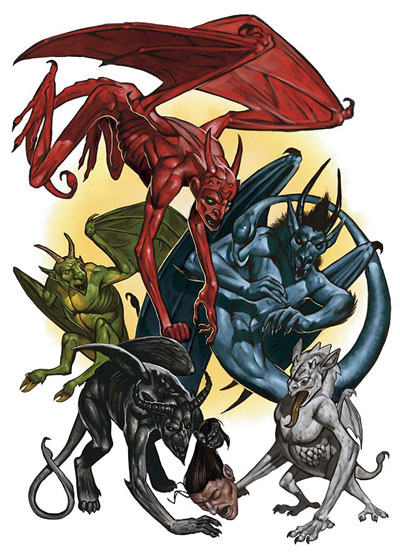
But so many of D&D's fiends feel like... well, strange hodgepodges of thrown-together animal parts with a random assortment of magical spells. If I say "devil" or "demon" your brain probably doesn't leap to "insect person with ice powers" or "four-armed dog-gorilla with lobster claws", it's probably more like one of these bastards: exaggerated, funny-colored humans with goat horns and bat wings and tails with a little arrowhead thingy on them and fangs, and perhaps cloven hooves, conjuring up fire and darkness and either here to kick some unholy ass or buy your soul for wealth, power, or wishes, but either way here to make sure somebody goes to hell; the stuff of heavy metal album covers.
The weird thing is that most of the highest ranks of D&D's demons and devils look like this. Asmodeus, Orcus, Grazz't, they all look like devils and demons. But their underlings just don't click for me.
Of course I like the occasional possessor too. D&D never really had that, as far as I know, the closest it ever got was the Shadow Demon, which isn't too awful either, but even that only sort of felt like it was the thing.
So here's how it'll be. My next several posts, I'll give you some demons I might use. I'm not saying they're original. I'm not saying they're clever. I'm definitely not saying they're gonzo, they're about as far from that as you get. But if you want them, you'll have them.
So here's what this post is actually about: For a while now I haven't liked most D&D Demons or Devils and I never was able to put a finger on why. Until tonight. Tonight I realized that the ones that I like the best (Balors, Succubi, and Imps/Quasits, and to a lesser extent Malebranche/Cornugon and Abishai-- Abishai in particular, as they were illustrated in 3.5, are in my opinion particularly attractive) all have something in common. Or rather, that the ones I don't like all have something in common. Iconicness. Those three demons are all very recognizable, very easy to grok. And for me that's an important part of D&D's specialness-- it's built on images that just about anyone who's read a few fairy tales or mythology books or been to the movies in their lives understands well enough that they can follow along and work with. Even many of its monsters, I think, are easy to make sense of. A mind-flayer is a tentacle alien that eats brains. A carrion crawler is a big scavenger worm. An owlbear is exactly what the name suggests it would be. A Bulette is a land shark, literally. A rust monster is a silly looking animal that makes metal rust.
But so many of D&D's fiends feel like... well, strange hodgepodges of thrown-together animal parts with a random assortment of magical spells. If I say "devil" or "demon" your brain probably doesn't leap to "insect person with ice powers" or "four-armed dog-gorilla with lobster claws", it's probably more like one of these bastards: exaggerated, funny-colored humans with goat horns and bat wings and tails with a little arrowhead thingy on them and fangs, and perhaps cloven hooves, conjuring up fire and darkness and either here to kick some unholy ass or buy your soul for wealth, power, or wishes, but either way here to make sure somebody goes to hell; the stuff of heavy metal album covers.
The weird thing is that most of the highest ranks of D&D's demons and devils look like this. Asmodeus, Orcus, Grazz't, they all look like devils and demons. But their underlings just don't click for me.
Of course I like the occasional possessor too. D&D never really had that, as far as I know, the closest it ever got was the Shadow Demon, which isn't too awful either, but even that only sort of felt like it was the thing.
So here's how it'll be. My next several posts, I'll give you some demons I might use. I'm not saying they're original. I'm not saying they're clever. I'm definitely not saying they're gonzo, they're about as far from that as you get. But if you want them, you'll have them.
Saturday, August 17, 2013
Races for ACKS, part 1: The classics
I don't necessarily dislike race as class, and for sure ACKS has one of the best implementations of it. But you know, sometimes it isn't what I want. It's nothing wrong with me, and it's nothing wrong with ACKS, it's just good to have alternatives. So here's an alternative that I hope you'll find to your tastes. I'm not going to impose any class or level limitations on you because as far as I'm concerned, it's just not my place. Each race, in addition to their other benefits, has a list of proficiencies that they may treat as general or class proficiencies, whichever would be more beneficial at the moment.
I dunno, this is just an idea I dashed off over the course of an hour for the hell of it so I wouldn't mind hearing some feedback about it.
Dwarves: Dwarves gain the effects (and extra XP cost) of having a Dwarf value of 0 added to their class. Due to their short stature, dwarves may never use two-handed swords or longbows, regardless of their Fighting Value.
Dwarven Proficiencies: Armor Training*, Caving, Craft, Dungeon Bashing, Dwarven Brewing, Engineering, Goblin-Slaying, Illusion Resistance
Elves: Elves gain the effects (and extra XP cost) of having an Elf value of 0 added to their class.
Elvish Proficiencies: Alertness, Beast Friendship, Familiar, Naturalism, Passing Without Trace, Swashbuckling, Wakefulness, Weapon Finesse
Halflings: Due to their short stature, halflings may never use two-handed swords or longbows, regardless of their Fighting Value. Few halflings are experienced in adventuring, so even player character halflings begin without the Adventuring proficiency and must purchase it at the cost of a single proficiency.
A halfling value of 0 adds an XP cost of 150
At Halfling 0, all halflings gain the following powers:
Halfling Proficiencies: Adventuring, Alertness, Climbing, Combat Reflexes, Contortionism, Knowledge, Naturalism, Passing Without Trace, Skirmishing
- Like dwarves, halflings are Hardy people and reduce the target values for saves vs. blast/breath by 3 and the target values of all other saves by 4.
- Halflings are also strong-hearted and reduce the target values for saves against any sort of charm, fear, or mind-control effect by an additional 2 points.
- Halflings have Keen eyes and gain a +1 bonus to attack throws when using thrown or missile weapons.
- Outdoors, Halflings are tricky to spot, having the ability to seemingly disappear into woods and underbrush with a proficiency throw of 10+ on 1d20. In dungeons, a halfling who is motionless and quiet in cover can escape detection with a proficiency throw of 18+ on 1d20.
Humans: Humans do not incur any additional XP cost, and furthermore they begin with one additional proficiency due to their natural capacity for learning. Humans do not have any additional racial proficiencies.
I dunno, this is just an idea I dashed off over the course of an hour for the hell of it so I wouldn't mind hearing some feedback about it.
Saturday, May 25, 2013
House Rule: Inscribe Magic
Vaguely inspired by Talysman's recent thoughts on the Read Magic spell.
The reverse of Read Magic, known as Inscribe Magic allows the caster to inscribe a mark, pictogram, or message of up to six words or symbols in length plus the character level of the caster making the mark. If the caster wishes, she may make the mark unintelligible or even invisible except to readers whom she specifically designates. An invisible mark can be seen, but not understood, by use of a Detect Magic or See Invisible spell. Only a Read Magic or True Seeing spell will make the writing legible to someone who the caster does not wish to read the mark. Inscribe Magic may also be used to mark a living or undead creature, in which case it will fade after a number of weeks equal to the caster's level.
Labels:
ACKS,
BFRPG,
DnD,
gaming,
house rules,
it just came to me.,
OSR
Friday, May 3, 2013
Halflings for B/X
Because shut up, Tavis and Alex, Halflings are awesome. =P
Like most of my content this has not been playtested... yet.
The following is a General proficiency, but is only available to human classes that do not cast Arcane spells. Unlike most proficiencies it can only be taken at first level, and requires two proficiency slots.
Halfling: The character is a Halfling, a tiny relative of Dwarves and Humans. His lifespan is half again as long as members of his race, and he enjoys a +2 bonus to AC against creatures of man size or larger. Additionally, halflings, like Dwarves, are Hardy People so the target value for their saves vs. Blast/Breath are reduced by 3, and the target values of all other saves are reduced by 4. However, halflings are very small in size and are subject to the following additional restrictions:
Like most of my content this has not been playtested... yet.
The following is a General proficiency, but is only available to human classes that do not cast Arcane spells. Unlike most proficiencies it can only be taken at first level, and requires two proficiency slots.
Halfling: The character is a Halfling, a tiny relative of Dwarves and Humans. His lifespan is half again as long as members of his race, and he enjoys a +2 bonus to AC against creatures of man size or larger. Additionally, halflings, like Dwarves, are Hardy People so the target value for their saves vs. Blast/Breath are reduced by 3, and the target values of all other saves are reduced by 4. However, halflings are very small in size and are subject to the following additional restrictions:
- The maximum weight a halfling can carry is equal to 15 stone, plus his strength adjustment.
- A halfling cannnot use longbows, arbalests, or melee weapons that require two hands to use, and never uses the increased damage value for using battle axes, flails, maces, warhammers, spears, or swords two-handed.
- A halfling does not begin play with the Adventuring proficiency.
Thursday, May 2, 2013
Off topic: In which I write a poem
OUTSIDE
The one thing I miss about
Being in school
(It just might be the only)
Was how
On Friday afternoons
In April and May,
I'd look out the window
Or be
Dismissed for the weekend,
And how the world
Seemed full of promise
Outside.
The one thing I miss about
Being in school
(It just might be the only)
Was how
On Friday afternoons
In April and May,
I'd look out the window
Or be
Dismissed for the weekend,
And how the world
Seemed full of promise
Outside.
Subscribe to:
Posts (Atom)