Those of you who are my longtime readers (what few of you may be left...) know that one of my perpetual bugbears (as opposed to actual bugbears, of which I am quite fond) has been the archetype and role of the cleric in a setting. And while I'm not alone in this, it's always nice to get a little reminder that others think about it a lot too, as Anders has over at Mythlands-Erce. Go give his post some love.
I'm still not quite up to blogging regularly, but I do have some things that, I hope, will be ready for primetime that I can share soon. Maybe that will be the start I need for further work in the near future.
Showing posts with label class. Show all posts
Showing posts with label class. Show all posts
Saturday, May 14, 2016

Tuesday, April 22, 2014
The sorcerer, draft 3
Okay, I probably didn't need to spend two weeks thinking about this, but sometimes inspiration takes a little while to come.
For my next crack, I took some mechanical inspiration from the Witch class, though this is obviously an arcane caster rather than a divine one. There will be more bloodlines at some point, but I figured I'd go with what D&D considers its default (Draconic) and what Pathfinder considers its default first. In the meantime I'd like criticism on these, because I'm pretty sure we're still a ways away from a final draft, but at least now it should be playable.
SORCERER
Prime Requisite: CHA
Requirements: None
Hit Dice: 1d4
Maximum Level: 14
Sorcerers are humans born with an instinctive grasp of magic. Many claim descent from powerful wizards, or even from magical beings that assumed human form such as fey, elementals, or dragons. For a sorcerer, magic is not a skill that must be studied and refined, as a mage does, but an instinctive ability as natural and intuitive as breathing. Some societies are fearful of sorcerers, but others hold them in special reverence. Some suggest that the name "sorcerer" was originally applied as a pun, for they are a natural source of magic.
Sorcerers seldom train in the arts of warfare, preferring instead to rely upon their innate gifts to see them through danger. At first level, sorcerers hit an unarmored foe (AC 0) with an attack throw of 10+. They advance in attack throws and saving throws only two points every six levels of experience (i.e., half as fast as fighters). They may only fight with quarterstaffs, clubs, daggers, and darts. They are unable to use shields, fight with two weapons, or wear any kind of armor.
Sorcerers learn and cast arcane spells as mages of two-thirds their class level. The number and levels of spells the sorcerer can use in a single day is summarized on the Sorcerer Spell Progression table. Like a mage, the Sorcerer’s spell selection is limited to the spells in their repertoire. A sorcerer’s repertoire can include a number of spells up to the number and level of spells listed for their level, increased by their Charisma bonus. Unlike other arcane spellcasters, many sorcerers do without a physical spellbook, although changing their repertoire or learning a new spell still incurs similar costs for research and training. A sorcerer can use any magic items usable by mages.
Every sorcerer must bear a bloodline. a magical ancestry which gives them both their affinity for magic and a handful of other special abilities. When a sorcerer is created, select a bloodline for the character from the ones below (or work with your Judge to create a new one), and write down the spells and powers of the bloodline. Regardless, a sorcerer's bloodline grants Each bloodline automatically adds four spells to the Sorcerer's spell list at the spell levels designated below, which they may add to their repertoire in the usual way. If a copy of such a spell is found or placed on a scroll, the scroll will be usable only by casters who would otherwise have the spell on their list. Each also provides additional abilities at 1st, 2nd, 4th, and 9th levels.
Sorcerer Proficiency List: Alchemy, Battle Magic, Beast Friendship, Black Lore of Zahar, Collegiate Wizardry, Contemplation, Craft, Diplomacy, Elementalism, Elven Bloodline, Engineering, Familiar, Healing, Illusion Resistance, Knowledge, Language, Magical Engineering, Mapping, Mystic Aura, Naturalism, Quiet Magic, Performance, Prestidigitation, Profession, Sensing Power, Transmogrification, Soothsaying, Unflappable Casting
Arcane Sorcerer
Bonus spells:
2nd level: The very same instinctive attunement that lets an arcane sorcerer sense magical power makes it easy for them to see how best to overcome it. They gain the Battle Magic proficiency.
4th level: Through spending an hour in sorcerous meditation, an arcane sorcerer can regain the ability to cast a spell of a level they had previously expended. The sorcerer may practice sorcerous meditation as often as they wish, but may not regain the same level of spell more than once per day.
9th level: The most powerful arcane sorcerers unlock latent spell knowledge hidden deep in their ancestral memory, and may add any four spells to their class spell list. The arcane sorcerer can then add these spells to their repertoire following the usual procedure. If the spells are normally divine, then they are identical in every way to their divine counterparts. If a copy of such a spell is found or placed on a scroll, the scroll will be usable only by casters who would otherwise have the spell on their list.
Draconic Sorcerer
Bonus spells:
2nd level: Winged Flight
3rd level: Polymorph Self
4th level: Fear
5th level: Call Dragon
1st level: A draconic sorcerer's first mark of their heritage is often their piercing, dragonlike eyes. The draconic sorcerer gains infravision out to 30 feet.
2nd level: As the draconic sorcerer becomes more powerful, they become more like a dragon, gaining a handsome scaly hide. This hide provides them a natural armor class of 1.
4th level: The draconic sorcerer may project a fearsome aura that awes and frightens those in their presence. They gain a +2 bonus to reaction rolls to impress and intimidate those in their presence. If this bonus results in a total of 12 or more, the subjects act as if charmed in their presence.
9th level: Three times per day, but no more than once per hour, a draconic sorcerer may use the breath attack of their dragon ancestor, which deals 5d4 damage along either a cone 40 feet long and 20 feet wide at its far end (if fire or cold), a 20-foot diameter cloud (if toxic gas), or a 60-foot line (if lightning or acid). A successful saving throw against Blast/Breath reduces the damage by half. A draconic sorcerer gains a +2 bonus to any saving throws against damage of the same type as their breath weapon.
A draconic sorcerer who attempts draconic apotheosis does so at half cost.
For my next crack, I took some mechanical inspiration from the Witch class, though this is obviously an arcane caster rather than a divine one. There will be more bloodlines at some point, but I figured I'd go with what D&D considers its default (Draconic) and what Pathfinder considers its default first. In the meantime I'd like criticism on these, because I'm pretty sure we're still a ways away from a final draft, but at least now it should be playable.
SORCERER
Prime Requisite: CHA
Requirements: None
Hit Dice: 1d4
Maximum Level: 14
Sorcerers are humans born with an instinctive grasp of magic. Many claim descent from powerful wizards, or even from magical beings that assumed human form such as fey, elementals, or dragons. For a sorcerer, magic is not a skill that must be studied and refined, as a mage does, but an instinctive ability as natural and intuitive as breathing. Some societies are fearful of sorcerers, but others hold them in special reverence. Some suggest that the name "sorcerer" was originally applied as a pun, for they are a natural source of magic.
Sorcerers seldom train in the arts of warfare, preferring instead to rely upon their innate gifts to see them through danger. At first level, sorcerers hit an unarmored foe (AC 0) with an attack throw of 10+. They advance in attack throws and saving throws only two points every six levels of experience (i.e., half as fast as fighters). They may only fight with quarterstaffs, clubs, daggers, and darts. They are unable to use shields, fight with two weapons, or wear any kind of armor.
Sorcerers learn and cast arcane spells as mages of two-thirds their class level. The number and levels of spells the sorcerer can use in a single day is summarized on the Sorcerer Spell Progression table. Like a mage, the Sorcerer’s spell selection is limited to the spells in their repertoire. A sorcerer’s repertoire can include a number of spells up to the number and level of spells listed for their level, increased by their Charisma bonus. Unlike other arcane spellcasters, many sorcerers do without a physical spellbook, although changing their repertoire or learning a new spell still incurs similar costs for research and training. A sorcerer can use any magic items usable by mages.
Every sorcerer must bear a bloodline. a magical ancestry which gives them both their affinity for magic and a handful of other special abilities. When a sorcerer is created, select a bloodline for the character from the ones below (or work with your Judge to create a new one), and write down the spells and powers of the bloodline. Regardless, a sorcerer's bloodline grants Each bloodline automatically adds four spells to the Sorcerer's spell list at the spell levels designated below, which they may add to their repertoire in the usual way. If a copy of such a spell is found or placed on a scroll, the scroll will be usable only by casters who would otherwise have the spell on their list. Each also provides additional abilities at 1st, 2nd, 4th, and 9th levels.
Sorcerer Proficiency List: Alchemy, Battle Magic, Beast Friendship, Black Lore of Zahar, Collegiate Wizardry, Contemplation, Craft, Diplomacy, Elementalism, Elven Bloodline, Engineering, Familiar, Healing, Illusion Resistance, Knowledge, Language, Magical Engineering, Mapping, Mystic Aura, Naturalism, Quiet Magic, Performance, Prestidigitation, Profession, Sensing Power, Transmogrification, Soothsaying, Unflappable Casting
Arcane Sorcerer
Bonus spells:
1st level: Read Magic3rd level: Clairvoyance, Dispel Magic1st level: An arcane sorcerer is so keenly attuned to magic that they can instinctively sense spellcasters within 60' and estimate their relative level of power. They can tell when arcane magic has been used in the last 24 hours within the same vicinity, but not tell whether an item is magic unless it has been used in that time. Using this ability takes a turn.
4th level: Remove Curse*
2nd level: The very same instinctive attunement that lets an arcane sorcerer sense magical power makes it easy for them to see how best to overcome it. They gain the Battle Magic proficiency.
4th level: Through spending an hour in sorcerous meditation, an arcane sorcerer can regain the ability to cast a spell of a level they had previously expended. The sorcerer may practice sorcerous meditation as often as they wish, but may not regain the same level of spell more than once per day.
9th level: The most powerful arcane sorcerers unlock latent spell knowledge hidden deep in their ancestral memory, and may add any four spells to their class spell list. The arcane sorcerer can then add these spells to their repertoire following the usual procedure. If the spells are normally divine, then they are identical in every way to their divine counterparts. If a copy of such a spell is found or placed on a scroll, the scroll will be usable only by casters who would otherwise have the spell on their list.
Draconic Sorcerer
Bonus spells:
2nd level: Winged Flight
3rd level: Polymorph Self
4th level: Fear
5th level: Call Dragon
1st level: A draconic sorcerer's first mark of their heritage is often their piercing, dragonlike eyes. The draconic sorcerer gains infravision out to 30 feet.
2nd level: As the draconic sorcerer becomes more powerful, they become more like a dragon, gaining a handsome scaly hide. This hide provides them a natural armor class of 1.
4th level: The draconic sorcerer may project a fearsome aura that awes and frightens those in their presence. They gain a +2 bonus to reaction rolls to impress and intimidate those in their presence. If this bonus results in a total of 12 or more, the subjects act as if charmed in their presence.
9th level: Three times per day, but no more than once per hour, a draconic sorcerer may use the breath attack of their dragon ancestor, which deals 5d4 damage along either a cone 40 feet long and 20 feet wide at its far end (if fire or cold), a 20-foot diameter cloud (if toxic gas), or a 60-foot line (if lightning or acid). A successful saving throw against Blast/Breath reduces the damage by half. A draconic sorcerer gains a +2 bonus to any saving throws against damage of the same type as their breath weapon.
A draconic sorcerer who attempts draconic apotheosis does so at half cost.
|
Sorcerer level progression
|
Sorcerer Spell progression
|
|||||||
|
Experience
|
Level
|
Hit Dice
|
Level Title
|
1
|
2
|
3
|
4
|
5
|
|
0
|
1
|
1d4
|
Prodigy
|
1
|
-
|
-
|
-
|
-
|
|
2075
|
2
|
2d4
|
Curiosity
|
1
|
-
|
-
|
-
|
-
|
|
4150
|
3
|
3d4
|
Freak
|
2
|
-
|
-
|
-
|
-
|
|
8300
|
4
|
4d4
|
Spectacle
|
2
|
1
|
-
|
-
|
-
|
|
16,600
|
5
|
5d4
|
Whiz
|
2
|
1
|
-
|
-
|
-
|
|
33,200
|
6
|
6d4
|
Wonder
|
2
|
2
|
-
|
-
|
-
|
|
65,000
|
7
|
7d4
|
Phenomenon
|
2
|
2
|
1
|
-
|
-
|
|
130,000
|
8
|
8d4
|
Witchalok
|
2
|
2
|
1
|
-
|
-
|
|
280,000
|
9
|
9d4
|
Sorcerer
|
2
|
2
|
2
|
-
|
-
|
|
430,000
|
10
|
9d4+1
|
Sorcerer
|
3
|
2
|
2
|
1
|
-
|
|
580,000
|
11
|
9d4+2
|
Sorcerer
|
3
|
2
|
2
|
1
|
-
|
|
730,000
|
12
|
9d4+3
|
Sorcerer
|
3
|
3
|
2
|
2
|
-
|
|
880,000
|
13
|
9d4+4
|
Sorcerer
|
3
|
3
|
3
|
2
|
1
|
|
1,030,000
|
14
|
9d4+5
|
Sorcerer
|
3
|
3
|
3
|
2
|
1
|
Monday, March 17, 2014
The Sorcerer (An ACKS Class), second draft
ETA March 22: This is not up to my balance standards. I advise not using this version. I'll get a better one made eventually, I'm sure.
After thinking about it today I decided I wanted to try again and see if I couldn't get my Sorcerer to be a little more... street-legal. To that end I'm gonna give staggered custom powers that should put it in under four build points, as Tavis and Alex intended. Sadly, this means Sensing Power had to go back on the proficiency list... for now. This time around I (mostly) borrowed level titles from the excellent Blood and Treasure (Plus one sneaky Acquisitions, Inc. reference), but I still have no intention of employing them myself.
SORCERER
Prime Requisite: CHA
Requirements: None
Hit Dice: 1d4
Maximum Level: 14
Sorcerers are humans born with an instinctive grasp of magic. Many claim descent from wizards, or even from dragons that assumed human form. For a sorcerer, magic is not a skill that must be studied and refined like a mage does, but an instinctive ability as natural and intuitive as breathing. Some societies are fearful of sorcerers, but others hold them in special reverence. Some suggest that the name "sorcerer" was originally applied as a pun, for they are a natural source of magic.
Sorcerers seldom train in the arts of warfare, preferring instead to rely upon their innate gifts to see them through danger. At first level, sorcerers hit an unarmored foe (AC 0) with an attack throw of 10+. They advance in attack throws and saving throws only two points every six levels of experience (i.e., half as fast as fighters). They may only fight with quarterstaffs, clubs, daggers, and darts. They are unable to use shields, fight with two weapons, or wear any kind of armor.
Sorcerers learn and cast arcane spells as mages of two-thirds their class level. The number and levels of spells the sorcerer can use in a single day is summarized on the Sorcerer Spell Progression table. Like a mage, the Sorcerer’s spell selection is limited to the spells in their repertoire. A sorcerer’s repertoire can include a number of spells up to the number and level of spells listed for their level, increased by their Charisma bonus. Unlike other arcane spellcasters, many sorcerers do without a physical spellbook, although changing their repertoire or learning a new spell still incurs similar costs for research and training. A sorcerer can use any magic items usable by mages.
Each sorcerer also has a unique combination of spell-like abilities, chosen (or randomly determined) as they are attained on the Sorcerer Level Progression Table. A first-level sorcerer may use one first-level spell once per hour. At second level, the sorcerer gains a second first-level spell usable once per hour. At fourth level, the sorcerer gains one second-level spell, usable once every 8 hours. At tenth level, the sorcerer gains one third-level spell, usable once per day. At twelfth level, the sorcerer gains one fourth-level spell, usable once per week. Each of these spells takes one round to cast, and otherwise functions like a normal spell cast by a mage of their class level.
At 7th level, the sorcerer may begin to research spells, scribe magical scrolls, and brew potions, as if they were a mage of 5th level. Upon reaching 13th level, the sorcerer gains the ability to create magic items such as weapons, rings, and staffs as a mage of 9th level. They may also cast ritual spells and conduct other magical research as a mage of 11th level.
A sorcerer may also build a sanctum, often a great tower, when he reaches 9th level. They will then attract 1d6 apprentices of 1st-3rd level plus 2d6 normal men seeking to become mages or with the potential to become sorcerers. Their intelligence or charisma scores will be above average, but many will become discouraged from the rigorous mental training and quit after 1d6 months. While in the sorcerer’s service, apprentices must be provided food and lodging, but need not be paid wages. If the sorcerer builds a dungeon beneath or near their tower, monsters will start to arrive to dwell within, followed shortly by adventurers seeking to fight them.
Sorcerer Proficiency List: Alchemy, Battle Magic, Beast Friendship, Black Lore of Zahar, Collegiate Wizardry, Contemplation, Craft, Diplomacy, Elementalism, Elven Bloodline, Engineering, Familiar, Healing, Illusion Resistance, Knowledge, Language, Magical Engineering, Mapping, Mystic Aura, Naturalism, Quiet Magic, Performance, Prestidigitation, Profession, Sensing Power, Transmogrification, Soothsaying, Unflappable Casting
After thinking about it today I decided I wanted to try again and see if I couldn't get my Sorcerer to be a little more... street-legal. To that end I'm gonna give staggered custom powers that should put it in under four build points, as Tavis and Alex intended. Sadly, this means Sensing Power had to go back on the proficiency list... for now. This time around I (mostly) borrowed level titles from the excellent Blood and Treasure (Plus one sneaky Acquisitions, Inc. reference), but I still have no intention of employing them myself.
SORCERER
Prime Requisite: CHA
Requirements: None
Hit Dice: 1d4
Maximum Level: 14
Sorcerers are humans born with an instinctive grasp of magic. Many claim descent from wizards, or even from dragons that assumed human form. For a sorcerer, magic is not a skill that must be studied and refined like a mage does, but an instinctive ability as natural and intuitive as breathing. Some societies are fearful of sorcerers, but others hold them in special reverence. Some suggest that the name "sorcerer" was originally applied as a pun, for they are a natural source of magic.
Sorcerers seldom train in the arts of warfare, preferring instead to rely upon their innate gifts to see them through danger. At first level, sorcerers hit an unarmored foe (AC 0) with an attack throw of 10+. They advance in attack throws and saving throws only two points every six levels of experience (i.e., half as fast as fighters). They may only fight with quarterstaffs, clubs, daggers, and darts. They are unable to use shields, fight with two weapons, or wear any kind of armor.
Sorcerers learn and cast arcane spells as mages of two-thirds their class level. The number and levels of spells the sorcerer can use in a single day is summarized on the Sorcerer Spell Progression table. Like a mage, the Sorcerer’s spell selection is limited to the spells in their repertoire. A sorcerer’s repertoire can include a number of spells up to the number and level of spells listed for their level, increased by their Charisma bonus. Unlike other arcane spellcasters, many sorcerers do without a physical spellbook, although changing their repertoire or learning a new spell still incurs similar costs for research and training. A sorcerer can use any magic items usable by mages.
Each sorcerer also has a unique combination of spell-like abilities, chosen (or randomly determined) as they are attained on the Sorcerer Level Progression Table. A first-level sorcerer may use one first-level spell once per hour. At second level, the sorcerer gains a second first-level spell usable once per hour. At fourth level, the sorcerer gains one second-level spell, usable once every 8 hours. At tenth level, the sorcerer gains one third-level spell, usable once per day. At twelfth level, the sorcerer gains one fourth-level spell, usable once per week. Each of these spells takes one round to cast, and otherwise functions like a normal spell cast by a mage of their class level.
At 7th level, the sorcerer may begin to research spells, scribe magical scrolls, and brew potions, as if they were a mage of 5th level. Upon reaching 13th level, the sorcerer gains the ability to create magic items such as weapons, rings, and staffs as a mage of 9th level. They may also cast ritual spells and conduct other magical research as a mage of 11th level.
A sorcerer may also build a sanctum, often a great tower, when he reaches 9th level. They will then attract 1d6 apprentices of 1st-3rd level plus 2d6 normal men seeking to become mages or with the potential to become sorcerers. Their intelligence or charisma scores will be above average, but many will become discouraged from the rigorous mental training and quit after 1d6 months. While in the sorcerer’s service, apprentices must be provided food and lodging, but need not be paid wages. If the sorcerer builds a dungeon beneath or near their tower, monsters will start to arrive to dwell within, followed shortly by adventurers seeking to fight them.
Sorcerer Proficiency List: Alchemy, Battle Magic, Beast Friendship, Black Lore of Zahar, Collegiate Wizardry, Contemplation, Craft, Diplomacy, Elementalism, Elven Bloodline, Engineering, Familiar, Healing, Illusion Resistance, Knowledge, Language, Magical Engineering, Mapping, Mystic Aura, Naturalism, Quiet Magic, Performance, Prestidigitation, Profession, Sensing Power, Transmogrification, Soothsaying, Unflappable Casting
Sorcerer level progression
|
Sorcerer Spell progression
|
||||||||
Experience
|
Level
|
Hit Dice
|
Level Title
|
Special Abilities
|
1
|
2
|
3
|
4
|
5
|
0
|
1
|
1d4
|
Prodigy
|
1st level spell 1/hour
|
1
|
-
|
-
|
-
|
-
|
2075
|
2
|
2d4
|
Curiosity
|
1st level spell 1/hour
|
1
|
-
|
-
|
-
|
-
|
4150
|
3
|
3d4
|
Freak
|
-
|
2
|
-
|
-
|
-
|
-
|
8300
|
4
|
4d4
|
Spectacle
|
2nd level spell 1/8 hours
|
2
|
1
|
-
|
-
|
-
|
16,600
|
5
|
5d4
|
Whiz
|
-
|
2
|
1
|
-
|
-
|
-
|
33,200
|
6
|
6d4
|
Wonder
|
-
|
2
|
2
|
-
|
-
|
-
|
65,000
|
7
|
7d4
|
Phenomenon
|
-
|
2
|
2
|
1
|
-
|
-
|
130,000
|
8
|
8d4
|
Witchalok
|
-
|
2
|
2
|
1
|
-
|
-
|
280,000
|
9
|
9d4
|
Sorcerer
|
-
|
2
|
2
|
2
|
-
|
-
|
430,000
|
10
|
9d4+1
|
Sorcerer
|
3rd level spell 1/day
|
3
|
2
|
2
|
1
|
-
|
580,000
|
11
|
9d4+2
|
Sorcerer
|
-
|
3
|
2
|
2
|
1
|
-
|
730,000
|
12
|
9d4+3
|
Sorcerer
|
4th level spell 1/week
|
3
|
3
|
2
|
2
|
-
|
880,000
|
13
|
9d4+4
|
Sorcerer
|
-
|
3
|
3
|
3
|
2
|
1
|
1,030,000
|
14
|
9d4+5
|
Sorcerer
|
-
|
3
|
3
|
3
|
2
|
1
|
Sunday, March 16, 2014
The Sorcerer (An ACKS Class), first draft
I am perfectly aware that this technically breaks the ACKS custom class rules-- if it were broken down it would be worth 5 points and some change (Arcane 3, Thievery 2, and one extra custom power) but the final XP base is below that of the mage (though I have rounded it up to equal the mage to make everything neat and head off the balance concerns a little.)
The idea came to me last night when I happened to look at the gnome trickster class-- previous attempts at the sorcerer were very bloodline-focused, but this time I eschewed that in favor of making them naturally-gifted with arcane magic.
No level titles were provided because I don't much care for them.
This is very much a work in progress, so I'd definitely like to hear ideas on how it might be cleaned up.
SORCERER
Prime Requisite: CHA
Requirements: None
Hit Dice: 1d4
Maximum Level: 14
Sorcerers are humans born with an instinctive grasp of magic. Many claim descent from wizards, or even from dragons that assumed human form. For a sorcerer, magic is not a skill that must be studied and refined like a mage does, but an instinctive ability as natural and intuitive as breathing. Some societies are fearful of sorcerers, but others hold them in special reverence. Some suggest that the name "sorcerer" was originally applied as a pun, for they are a natural source of magic.
Sorcerers seldom train in the arts of warfare, preferring instead to rely upon their innate gifts to see them through danger. At first level, sorcerers hit an unarmored foe (AC 0) with an attack throw of 10+. They advance in attack throws and saving throws only two points every six levels of experience (i.e., half as fast as fighters). They may only fight with quarterstaffs, clubs, daggers, and darts. They are unable to use shields, fight with two weapons, or wear any kind of armor.
A sorcerer is so attuned to magic that they may sense power, as the proficiency of the same name. Each sorcerer also has a unique combination of spell-like abilities, chosen (or randomly determined) at the time of their creation. Once per hour, a sorcerer may use two first-level arcane spells. Once per 8 hours, they can cast two second-level arcane spells. Once per day they can cast one third-level arcane spell. Each of these spells takes one round to cast, and otherwise functions like a normal spell cast by a mage of his class level.
Sorcerers learn and cast arcane spells as mages of two-thirds their class level. The number and levels of spells the sorcerer can use in a single day is summarized on the Sorcerer Spell Progression table. Like a mage, the Sorcerer’s spell selection is limited to the spells in their repertoire. A sorcerer’s repertoire can include a number of spells up to the number and level of spells listed for their level, increased by their Charisma bonus. Unlike other arcane spellcasters, many sorcerers do without a physical spellbook, although changing their repertoire or learning a new spell still incurs similar costs for research and training. A sorcerer can use any magic items usable by mages.
At 7th level, the sorcerer may begin to research spells, scribe magical scrolls, and brew potions, as if he were a mage of 5th level. Upon reaching 13th level, the sorcerer gains the ability to create magic items such as weapons, rings, and staffs as a mage of 9th level. They may also cast ritual spells and conduct other magical research as a mage of 11th level.
A sorcerer may also build a sanctum, often a great tower, when he reaches 9th level. He will then attract 1d6 apprentices of 1st-3rd level plus 2d6 normal men seeking to become mages or with the potential to become sorcerers. Their intelligence or charisma scores will be above average, but many will become discouraged from the rigorous mental training and quit after 1d6 months. While in the sorcerer’s service, apprentices must be provided food and lodging, but need not be paid wages. If the sorcerer builds a dungeon beneath or near his tower, monsters will start to arrive to dwell within, followed shortly by adventurers seeking to fight them.
Sorcerer Proficiency List: Alchemy, Apostasy, Battle Magic, Beast Friendship, Black Lore of Zahar, Collegiate Wizardry, Contemplation, Craft, Diplomacy, Elementalism, Elven Bloodline, Engineering, Familiar, Healing, Illusion Resistance, Knowledge, Language, Magical Engineering, Mapping, Mystic Aura, Naturalism, Quiet Magic, Performance, Prestidigitation, Profession, Transmogrification, Soothsaying, Unflappable Casting
The idea came to me last night when I happened to look at the gnome trickster class-- previous attempts at the sorcerer were very bloodline-focused, but this time I eschewed that in favor of making them naturally-gifted with arcane magic.
No level titles were provided because I don't much care for them.
This is very much a work in progress, so I'd definitely like to hear ideas on how it might be cleaned up.
SORCERER
Prime Requisite: CHA
Requirements: None
Hit Dice: 1d4
Maximum Level: 14
Sorcerers are humans born with an instinctive grasp of magic. Many claim descent from wizards, or even from dragons that assumed human form. For a sorcerer, magic is not a skill that must be studied and refined like a mage does, but an instinctive ability as natural and intuitive as breathing. Some societies are fearful of sorcerers, but others hold them in special reverence. Some suggest that the name "sorcerer" was originally applied as a pun, for they are a natural source of magic.
Sorcerers seldom train in the arts of warfare, preferring instead to rely upon their innate gifts to see them through danger. At first level, sorcerers hit an unarmored foe (AC 0) with an attack throw of 10+. They advance in attack throws and saving throws only two points every six levels of experience (i.e., half as fast as fighters). They may only fight with quarterstaffs, clubs, daggers, and darts. They are unable to use shields, fight with two weapons, or wear any kind of armor.
A sorcerer is so attuned to magic that they may sense power, as the proficiency of the same name. Each sorcerer also has a unique combination of spell-like abilities, chosen (or randomly determined) at the time of their creation. Once per hour, a sorcerer may use two first-level arcane spells. Once per 8 hours, they can cast two second-level arcane spells. Once per day they can cast one third-level arcane spell. Each of these spells takes one round to cast, and otherwise functions like a normal spell cast by a mage of his class level.
Sorcerers learn and cast arcane spells as mages of two-thirds their class level. The number and levels of spells the sorcerer can use in a single day is summarized on the Sorcerer Spell Progression table. Like a mage, the Sorcerer’s spell selection is limited to the spells in their repertoire. A sorcerer’s repertoire can include a number of spells up to the number and level of spells listed for their level, increased by their Charisma bonus. Unlike other arcane spellcasters, many sorcerers do without a physical spellbook, although changing their repertoire or learning a new spell still incurs similar costs for research and training. A sorcerer can use any magic items usable by mages.
At 7th level, the sorcerer may begin to research spells, scribe magical scrolls, and brew potions, as if he were a mage of 5th level. Upon reaching 13th level, the sorcerer gains the ability to create magic items such as weapons, rings, and staffs as a mage of 9th level. They may also cast ritual spells and conduct other magical research as a mage of 11th level.
A sorcerer may also build a sanctum, often a great tower, when he reaches 9th level. He will then attract 1d6 apprentices of 1st-3rd level plus 2d6 normal men seeking to become mages or with the potential to become sorcerers. Their intelligence or charisma scores will be above average, but many will become discouraged from the rigorous mental training and quit after 1d6 months. While in the sorcerer’s service, apprentices must be provided food and lodging, but need not be paid wages. If the sorcerer builds a dungeon beneath or near his tower, monsters will start to arrive to dwell within, followed shortly by adventurers seeking to fight them.
Sorcerer Proficiency List: Alchemy, Apostasy, Battle Magic, Beast Friendship, Black Lore of Zahar, Collegiate Wizardry, Contemplation, Craft, Diplomacy, Elementalism, Elven Bloodline, Engineering, Familiar, Healing, Illusion Resistance, Knowledge, Language, Magical Engineering, Mapping, Mystic Aura, Naturalism, Quiet Magic, Performance, Prestidigitation, Profession, Transmogrification, Soothsaying, Unflappable Casting
Sorcerer level progression
|
Sorcerer Spell progression
|
||||||
Experience
|
Level
|
Hit Dice
|
1
|
2
|
3
|
4
|
5
|
0
|
1
|
1d4
|
1
|
-
|
-
|
-
|
-
|
2500
|
2
|
2d4
|
1
|
-
|
-
|
-
|
-
|
5000
|
3
|
3d4
|
2
|
-
|
-
|
-
|
-
|
10,000
|
4
|
4d4
|
2
|
1
|
-
|
-
|
-
|
20,000
|
5
|
5d4
|
2
|
1
|
-
|
-
|
-
|
40,000
|
6
|
6d4
|
2
|
2
|
-
|
-
|
-
|
80,000
|
7
|
7d4
|
2
|
2
|
1
|
-
|
-
|
160,000
|
8
|
8d4
|
2
|
2
|
1
|
-
|
-
|
310,000
|
9
|
9d4
|
2
|
2
|
2
|
-
|
-
|
460,000
|
10
|
9d4+1
|
3
|
2
|
2
|
1
|
-
|
610,000
|
11
|
9d4+2
|
3
|
2
|
2
|
1
|
-
|
760,000
|
12
|
9d4+3
|
3
|
3
|
2
|
2
|
-
|
910,000
|
13
|
9d4+4
|
3
|
3
|
3
|
2
|
1
|
1,060,000
|
14
|
9d4+5
|
3
|
3
|
3
|
2
|
1
|
Monday, January 6, 2014
Thinking more about the Sorcerer
The first place I looked was an OSR game that I knew used sorcerers: Blood and Treasure. B&T, of course, takes a lot more from 3rd edition than many OSR games, and this of course means that it has a Sorcerer class. The one present there is pretty much a straight adaptation of the 3.x one, sacrificing the potential diversity of a spellbook for spontaneous casting and more spells per day.
Now this does have the advantage of being very simple and straightforward, which is usually a useful thing, but I can't help but think that I'd like a little more emphasis on the sorcerer's magical bloodline-- this is something that both 4e and Pathfinder did with their interpretations. 4e, solid game though it is, suffers from compatibility issues, so I think my next avenue of research should be to look a little at how Pathfinder did things. I think one release or the other of Dangers and Dweomers did something like that too, so I'll consult that as well. Either way, not too much emphasis, just... something. Either way I think a draft might be coming in the next 2-3 days.
Update: A little crossreferencing suggests that a lot of what Luigi went with was to borrow elements from the PF bloodlines. I don't know if I'll do the same, but it does provide food for thought at least.
Update: A little crossreferencing suggests that a lot of what Luigi went with was to borrow elements from the PF bloodlines. I don't know if I'll do the same, but it does provide food for thought at least.
Sunday, January 5, 2014
Towards old-school-izing two new school classes... but not the usual two!
I (And a lot of others) have fiddled around since 4e's release with bringing the Warlock and the Warlord into an old-school paradigm. That's been done enough, and successfully enough, that it's not what I'm here to talk about.
I think I want to go after two other newer classes: the 3.x/4e/PF Sorcerer, and the PF Oracle. I've always liked the idea behind the sorcerer, the natural aptitude for magic is an interesting variation... especially with the magical bloodline fluff that both Paizo and WOTC went on to implement in it. I don't yet know how I'm gonna work it, especially if I want to keep things simple, but I'm going to do a little researching, and maybe discuss it around the usual places, and see what ideas there are to see.
The Oracle I know less intimately, but it seems to me to stand as a take on the Cleric concept that is less fraught with the implicit assumptions that have so frustrated me on this blog (even if I've learned to live with them... it would still simplify my life to not have to. So I want to see where I can take that.)
Tuesday, December 3, 2013
Killing the Cleric (Probably Not The last Cleric post after all)
Well, I arrived at that decision surprisingly quickly. And it was like a weight off my shoulders when I did.
As you know, or at least can see from five minutes in my archives, I've thrown away days of my life researching and trying to come up with a religious framework that is not Crystal Dragon Jesus, but adequately leaves room for the spells and class features typical of the cleric, which is loaded down with a lot of implicitly-middle-class-American-Christian ideas about both gods and holy men. Some may enjoy that, and far be it from me to condemn them, but for me it always seemed a little... intellectually lazy. So I had some cognitive dissonance to work through.
It has been less of a challenge and more of a vexation, frankly.
So, I got to thinking, something has to give, either I have to learn to stop worrying and love Crystal Dragon Jesus, or I need to stop trying to fit his vaguely-cross-shaped peg into my round fantasy hole. Apart from which, I think it's just not terribly compatible with my largely non-theistic (though not atheistic) take on the world... not to sound hidebound of course, but I just do not give a damn about the existence or worship of gods one way or another, and there's nothing worse for a story than not giving a damn about its subject material.
There is something that does come a little more naturally to me though, in terms of the human relationship with forces that are, by and large, beyond it: the sort of "virtuous pagan" attitude that seems to come standard for the good guys in Tolkien. Of course I come to it for different reasons-- him writing an intentionally Catholic work, and me, as I said, just plain not being arsed about gods in the first place. But that same sort of attitude-- reverence toward nature/the universe, song, belief in good and courage and stuff... that I can write for. Now, a druid (in the fantasy sense of the term, at least) or a witch, I think, can reconcile easily with that worldview, but not so much a cleric.
I think, despite my initial reservations, that just passing most of the spells that aren't already duplicated over to the Magic-User is probably a good start. Particularly if I just go with Wound Points and Vitality Points-- I think VP/WP reduces some of the burden on spellcasters to always have healing prepped (especially if healing only works on WP) because VP regenerates comparatively quickly.
The big mechanical problem I found myself stuck on, then, was what to do about the other vital function of clerics, the one which Mike Mornard and his friends originally demanded the creation of the Cleric for: Turn Undead. I've seen some retroclones make it a spell as well (usually a 2nd level one), but I wasn't sure if that was the best option. But I was concerned both from a gameplay perspective (that making it a spell might make it too scarce comparatively, making undead particularly nasty and killer opponents), and a thematic perspective (just what is the spell doing?).
To be honest I sort of always thought of it being like the "True faith" feat or advantage in many other RPGs... which... honestly doesn't make much sense given that paladins tend to be both more zealous in general and less effective at turning. Of course there's the 3.5 answer: that it's somehow channeling a positive energy that's anathema to undead... but the check for it is weird, in that case, isn't it?
But then... the fact that Energy Drain is one of those other things that just bugs me means undead lose a bit of their teeth in the first place, maybe I don't need Turn Undead so badly. So that was it. Kill the Cleric, pass on its spells to the Magic-User. My life is simpler now.
Of course this doesn't mean there isn't religion, but ditching the character class explicitly focused upon it means there's less of an obligation on my part to try to force together something that isn't crypto-Christian but where there's still somehow a militant order of priests that use maces and wear armor and heal and part the ocean and scare the undead and stuff. If I need priests or a temple for a story, or even if I have a player who wants a religiously-inclined character, I can make up something that works for the scenario I want to provide or the story they want to tell. And that's... extremely liberating.
As you know, or at least can see from five minutes in my archives, I've thrown away days of my life researching and trying to come up with a religious framework that is not Crystal Dragon Jesus, but adequately leaves room for the spells and class features typical of the cleric, which is loaded down with a lot of implicitly-middle-class-American-Christian ideas about both gods and holy men. Some may enjoy that, and far be it from me to condemn them, but for me it always seemed a little... intellectually lazy. So I had some cognitive dissonance to work through.
It has been less of a challenge and more of a vexation, frankly.
So, I got to thinking, something has to give, either I have to learn to stop worrying and love Crystal Dragon Jesus, or I need to stop trying to fit his vaguely-cross-shaped peg into my round fantasy hole. Apart from which, I think it's just not terribly compatible with my largely non-theistic (though not atheistic) take on the world... not to sound hidebound of course, but I just do not give a damn about the existence or worship of gods one way or another, and there's nothing worse for a story than not giving a damn about its subject material.
There is something that does come a little more naturally to me though, in terms of the human relationship with forces that are, by and large, beyond it: the sort of "virtuous pagan" attitude that seems to come standard for the good guys in Tolkien. Of course I come to it for different reasons-- him writing an intentionally Catholic work, and me, as I said, just plain not being arsed about gods in the first place. But that same sort of attitude-- reverence toward nature/the universe, song, belief in good and courage and stuff... that I can write for. Now, a druid (in the fantasy sense of the term, at least) or a witch, I think, can reconcile easily with that worldview, but not so much a cleric.
I think, despite my initial reservations, that just passing most of the spells that aren't already duplicated over to the Magic-User is probably a good start. Particularly if I just go with Wound Points and Vitality Points-- I think VP/WP reduces some of the burden on spellcasters to always have healing prepped (especially if healing only works on WP) because VP regenerates comparatively quickly.
The big mechanical problem I found myself stuck on, then, was what to do about the other vital function of clerics, the one which Mike Mornard and his friends originally demanded the creation of the Cleric for: Turn Undead. I've seen some retroclones make it a spell as well (usually a 2nd level one), but I wasn't sure if that was the best option. But I was concerned both from a gameplay perspective (that making it a spell might make it too scarce comparatively, making undead particularly nasty and killer opponents), and a thematic perspective (just what is the spell doing?).
To be honest I sort of always thought of it being like the "True faith" feat or advantage in many other RPGs... which... honestly doesn't make much sense given that paladins tend to be both more zealous in general and less effective at turning. Of course there's the 3.5 answer: that it's somehow channeling a positive energy that's anathema to undead... but the check for it is weird, in that case, isn't it?
But then... the fact that Energy Drain is one of those other things that just bugs me means undead lose a bit of their teeth in the first place, maybe I don't need Turn Undead so badly. So that was it. Kill the Cleric, pass on its spells to the Magic-User. My life is simpler now.
Of course this doesn't mean there isn't religion, but ditching the character class explicitly focused upon it means there's less of an obligation on my part to try to force together something that isn't crypto-Christian but where there's still somehow a militant order of priests that use maces and wear armor and heal and part the ocean and scare the undead and stuff. If I need priests or a temple for a story, or even if I have a player who wants a religiously-inclined character, I can make up something that works for the scenario I want to provide or the story they want to tell. And that's... extremely liberating.
Monday, December 2, 2013
The Cleric: a gamepiece
Regular readers of this blog (All five of you) are aware that the existence of the Cleric (and what sort of religion she might belong to other than the to-me-unsatisfying choice of Fantasy Pseudo-Christianity #326?) is something with which I often grapple. Some might ask why I bother, when instead I could just drop the silly thing from my worlds altogether and save a lot of hassle. To them I would say that it is because I think of D&D mainly as a game, with the classes being different kinds of pieces. Therefore, I am concerned with the unforeseen impact on gameplay that might be had by either denying the functions it provides, or shunting them off to another character class-- most likely the Wizard/Magic-User. Frankly this is mostly just a ramble, but it seems that something or other has to give eventually. Will I stop worrying and learn to love Crystal Dragon Jesus? Will I just kick the cleric to the curb? It remains to be seen.
Thursday, November 14, 2013
Aventures in the East Mark Explorer
So Adventures in the East Mark, which recently kickstarted its English release, offered a preview of its Explorer class, which I downloaded today. Rangers happen to have been my favorite class for as long as I've been playing D&D, but the AD&D interpretation of them never quite rubbed me right. But I remain fond of the concept and whenever I see that someone has a take on them, I like to give it a look. This time around, I think I like what I see and I may just use it next time I have need of a ranger. They don't seem to have included attack or save tables for it in the preview, though. I figure, just on eyeballing, that Cleric attack tables and Fighter saves would probably be fair. But if anyone's got it already (either the translation or the original Spanish release) and wants to correct my guess, that would be great too.
Saturday, August 24, 2013
New-school race-as-classes part the third: Tieflings
I mean, I guess Tieflings aren't really that new school given they were in 2e, but 4e took them in a particular direction that I quite liked. I'm not 100% happy with it yet, so if you think there's something that needs changing I'm not above putting out a second draft. UPDATED 8/26: Make that a third draft, thanks to Anonymous Commenter #1.
Tiefling

Requirements: INT 9
Hit Dice: 1d6
Attack as: Fighter
Save as: Elf
Advance as: Elf
Maximum level: 10
Tieflings are the descendants of nobles of a decadent human empire that entered into a series of alliances (both military and marital) with the forces of Chaos. They resemble devilish humanoids with an aristocratic bearing, and often have reddish, grey, or stark white skin, horns, and tails. Some have cloven hooves for feet. In the Wilderlands, Tieflings are also known as Viridians and tend towards green skin instead. Tieflings tend to be about the same height (not counting their horns) and weight as humans.
Restrictions: Tieflings use 6-sided dice (d6) to determine their hit points. They may advance to a maximum of the 10th level of experience. Tieflings may use any type of weapon or armor and may use shields. A Tiefling character must have a minimum Intelligence of 9.
Special Abilities: Tieflings have infravision and can see 60 feet in the dark. They cast spells as Magic-Users or Elves of two thirds their level, as detailed on the chart below. Tieflings are immune to fear effects. While wearing leather armor or less, a tiefling may hide in shadows, move silently, and backstab as a thief of the same level. Inherently Chaotic monsters still often remember the old pacts made between them and the first Tieflings and so apply a +2 bonus to their reaction rolls and a -2 penalty to saving throws against any Charm spells the Tiefling uses against them.
Table: Tiefling spells by level
Tieflings:
AC: 5 (14)
HD: 1+1
Move: 120' (40')
Attacks: 1 weapon Damage: 1d8 or by weapon
# Appearing: 1d4 (2d12)
Save as: E1
Morale: 8
Treasure Type: E
Alignment: Neutral or Chaotic
Tieflings are handsome, devilish-looking humanoids. Each tiefling will have one first level spell (chosen at random) If a group of 15 or more Tieflings appear, one will be a leader of level 2-7 (1d6+1). To check for magic items the leader may own, multiply the leader's level by 5. The result is the percentage chance for that leader to have a magic item from any subtable. Roll separately for every subtable. So long as the leader is alive morale is 10 rather than 8.
Tiefling
Art
by Zaebrael (you have no idea how hard it is to find a female
tiefling in reasonable armor!)
Prime requisite: STR and INTRequirements: INT 9
Hit Dice: 1d6
Attack as: Fighter
Save as: Elf
Advance as: Elf
Maximum level: 10
Tieflings are the descendants of nobles of a decadent human empire that entered into a series of alliances (both military and marital) with the forces of Chaos. They resemble devilish humanoids with an aristocratic bearing, and often have reddish, grey, or stark white skin, horns, and tails. Some have cloven hooves for feet. In the Wilderlands, Tieflings are also known as Viridians and tend towards green skin instead. Tieflings tend to be about the same height (not counting their horns) and weight as humans.
Restrictions: Tieflings use 6-sided dice (d6) to determine their hit points. They may advance to a maximum of the 10th level of experience. Tieflings may use any type of weapon or armor and may use shields. A Tiefling character must have a minimum Intelligence of 9.
Special Abilities: Tieflings have infravision and can see 60 feet in the dark. They cast spells as Magic-Users or Elves of two thirds their level, as detailed on the chart below. Tieflings are immune to fear effects. While wearing leather armor or less, a tiefling may hide in shadows, move silently, and backstab as a thief of the same level. Inherently Chaotic monsters still often remember the old pacts made between them and the first Tieflings and so apply a +2 bonus to their reaction rolls and a -2 penalty to saving throws against any Charm spells the Tiefling uses against them.
Table: Tiefling spells by level
Character Level
|
1st level spells
|
2nd level spells
|
3rd level spells
|
4th level spells
|
1
|
1
|
-
|
-
|
-
|
2
|
1
|
-
|
-
|
-
|
3
|
2
|
-
|
-
|
-
|
4
|
2
|
1
|
-
|
-
|
5
|
2
|
1
|
-
|
-
|
6
|
2
|
2
|
-
|
-
|
7
|
2
|
2
|
1
|
-
|
8
|
2
|
2
|
1
|
-
|
9
|
2
|
2
|
2
|
-
|
10
|
3
|
2
|
2
|
1
|
Tieflings:
AC: 5 (14)
HD: 1+1
Move: 120' (40')
Attacks: 1 weapon Damage: 1d8 or by weapon
# Appearing: 1d4 (2d12)
Save as: E1
Morale: 8
Treasure Type: E
Alignment: Neutral or Chaotic
Tieflings are handsome, devilish-looking humanoids. Each tiefling will have one first level spell (chosen at random) If a group of 15 or more Tieflings appear, one will be a leader of level 2-7 (1d6+1). To check for magic items the leader may own, multiply the leader's level by 5. The result is the percentage chance for that leader to have a magic item from any subtable. Roll separately for every subtable. So long as the leader is alive morale is 10 rather than 8.
Thursday, August 22, 2013
New-school race as classes 2: The Warforged
This will probably be a three-part series, with the last part being a tiefling. I mean I know last time I said the ruinguard from ACKS, but... I dunno, I have some thoughts about de-ACKS-izing it at the least. (I like ACKS but I dunno, I'm having fun here.) Those three are my favorites.
Warforged
Requirements: STR 9
Hit Dice: 1d8
Attack as: Fighter
Save as: Dwarf
Advance as: Dwarf
Maximum level: 10
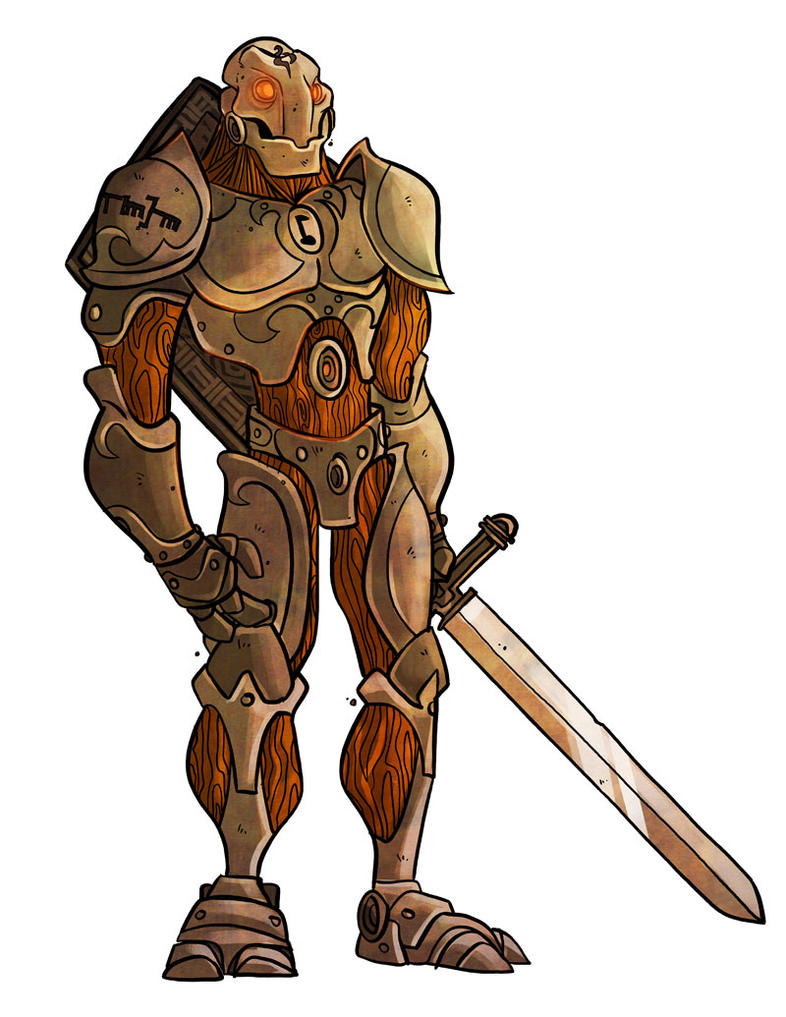
Warforged are artificially-constructed beings made of a wooden, leather, and metal frame covered in armor-like steel plates, brought to life by means of magical and alchemical processes. They were created for a war that has since been consigned to history, and in the intervening years the secret of their creation has been lost. Despite their artificial appearances, warforged are self-aware and are often surprisingly "human" in their outlook. With the war they were built to fight gone, many turn to adventuring in hopes of finding a new purpose in life. Apart from the color of their eyes and a serial rune on the crown of their heads, all warforged look essentially alike to human eyes, though some paint identifying markings upon themselves. A warforged stands six feet tall and weighs 275 pounds. Although their bulky, somewhat angular appearance suggests masculinity to human eyes, most warforged are not strongly concerned with gender (though they have no problem going along with whatever gender others are comfortable assigning them).
Restrictions: Warforged use 8-sided dice (d8) to determine their hit points. They may advance to a maximum of the 10th level of experience. Warforged may use any type of weapon, and may use shields. Because they are already covered in armor-like plates of metal, any armor they wear must be specially-fitted and costs twice as much. Because of their wooden-and-metal construction, magical effects involving metal or wood affect them*. Warforged characters do not heal on their own and receive only half the normal effect of healing magic, but they can be repaired by any skilled armorer with access to a forge with one hour of work per point of damage suffered. A Warforged character must have a minimum Strength of 9.
Special Abilities: Warforged are covered in sturdy metal plating that grants them a -2(+2) bonus to their armor class. Although they have souls and are alive, warforged are immune to the effects of fatigue, disease, and poison, and have no need to eat, drink, sleep, or breathe (however poison gas such as the breath weapons of green dragons is still dangerous to them because it is corrosive to their organic components). Warforged do, however, have minds and souls and can thus be charmed, held, or raised from the dead like any other person.
Warforged
AC: 4 (15)
HD: 1+1
Move: 120' (40')
Attacks: 1 weapon
Damage: 1d8 or by weapon
# Appearing: 1d6 (2d10)
Save as: F1
Morale: 8
Treasure Type: B
Alignment: Neutral
Warforged are artificial people made primarily of leather, wood, and steel. They are immune to poison, disease, and sleep effects. If a group of 15 or more Warforged appear, one will be a leader of level 3-8 (1d6+2). To check for magic items the leader may own, multiply the leader's level by 5. The result is the percentage chance for that leader to have a magic item from any subtable except the Scroll and Wand/Staff/Rod subtables**. So long as the leader is alive, morale is 10 instead of 8.
*For instance, a rust monster may use their feelers to consume a warforged's plating and other metal components, dealing 2d6 damage per round and negating their armor bonus***. If you use Rules Cyclopedia-style Druids in your campaign, they always count as holding a metal object for purposes of Heat Metal, Turn Wood repels them on a failed save, and Metal to Wood reduces their AC bonus by 1***. Warp Wood only affects objects, and thus does not affect Warforged.
**If the leader would otherwise wear magical armor, then their plating is enchanted instead. A warforged may remove such plating in order to use it for theirself***.
***New plating costs as much as plate armor. A warforged may replace their plating in an hour with the help of a skilled armorer with access to a forge.
UPDATE: Edited for clarity
Warforged
Art
by Gabe
Prime requisite: STRRequirements: STR 9
Hit Dice: 1d8
Attack as: Fighter
Save as: Dwarf
Advance as: Dwarf
Maximum level: 10
Warforged are artificially-constructed beings made of a wooden, leather, and metal frame covered in armor-like steel plates, brought to life by means of magical and alchemical processes. They were created for a war that has since been consigned to history, and in the intervening years the secret of their creation has been lost. Despite their artificial appearances, warforged are self-aware and are often surprisingly "human" in their outlook. With the war they were built to fight gone, many turn to adventuring in hopes of finding a new purpose in life. Apart from the color of their eyes and a serial rune on the crown of their heads, all warforged look essentially alike to human eyes, though some paint identifying markings upon themselves. A warforged stands six feet tall and weighs 275 pounds. Although their bulky, somewhat angular appearance suggests masculinity to human eyes, most warforged are not strongly concerned with gender (though they have no problem going along with whatever gender others are comfortable assigning them).
Restrictions: Warforged use 8-sided dice (d8) to determine their hit points. They may advance to a maximum of the 10th level of experience. Warforged may use any type of weapon, and may use shields. Because they are already covered in armor-like plates of metal, any armor they wear must be specially-fitted and costs twice as much. Because of their wooden-and-metal construction, magical effects involving metal or wood affect them*. Warforged characters do not heal on their own and receive only half the normal effect of healing magic, but they can be repaired by any skilled armorer with access to a forge with one hour of work per point of damage suffered. A Warforged character must have a minimum Strength of 9.
Special Abilities: Warforged are covered in sturdy metal plating that grants them a -2(+2) bonus to their armor class. Although they have souls and are alive, warforged are immune to the effects of fatigue, disease, and poison, and have no need to eat, drink, sleep, or breathe (however poison gas such as the breath weapons of green dragons is still dangerous to them because it is corrosive to their organic components). Warforged do, however, have minds and souls and can thus be charmed, held, or raised from the dead like any other person.
Warforged
AC: 4 (15)
HD: 1+1
Move: 120' (40')
Attacks: 1 weapon
Damage: 1d8 or by weapon
# Appearing: 1d6 (2d10)
Save as: F1
Morale: 8
Treasure Type: B
Alignment: Neutral
Warforged are artificial people made primarily of leather, wood, and steel. They are immune to poison, disease, and sleep effects. If a group of 15 or more Warforged appear, one will be a leader of level 3-8 (1d6+2). To check for magic items the leader may own, multiply the leader's level by 5. The result is the percentage chance for that leader to have a magic item from any subtable except the Scroll and Wand/Staff/Rod subtables**. So long as the leader is alive, morale is 10 instead of 8.
*For instance, a rust monster may use their feelers to consume a warforged's plating and other metal components, dealing 2d6 damage per round and negating their armor bonus***. If you use Rules Cyclopedia-style Druids in your campaign, they always count as holding a metal object for purposes of Heat Metal, Turn Wood repels them on a failed save, and Metal to Wood reduces their AC bonus by 1***. Warp Wood only affects objects, and thus does not affect Warforged.
**If the leader would otherwise wear magical armor, then their plating is enchanted instead. A warforged may remove such plating in order to use it for theirself***.
***New plating costs as much as plate armor. A warforged may replace their plating in an hour with the help of a skilled armorer with access to a forge.
UPDATE: Edited for clarity
Tuesday, August 20, 2013
B/X class: I tell you, I tell you the Dragonborn comes (50th post wooo!)
Okay so I haven't thought this out 100%-- I was going to start by building this using the ACKS custom class guidelines, but I got impatient. As usual, honest criticism is the only way I'll learn. (For those of you playing at home, the ACKS Zaharan Ruinguard is the corresponding Tiefling class)
UPDATE: Here it is as a one-page, easy-to-print PDF if you want one.
Dragonborn
Prime requisite: STR
Requirements: STR 9, CHA 7
Hit Dice: 1d8
Attack as: Fighter
Save as: Fighter
Advance as: Magic-Users
Maximum level: 11
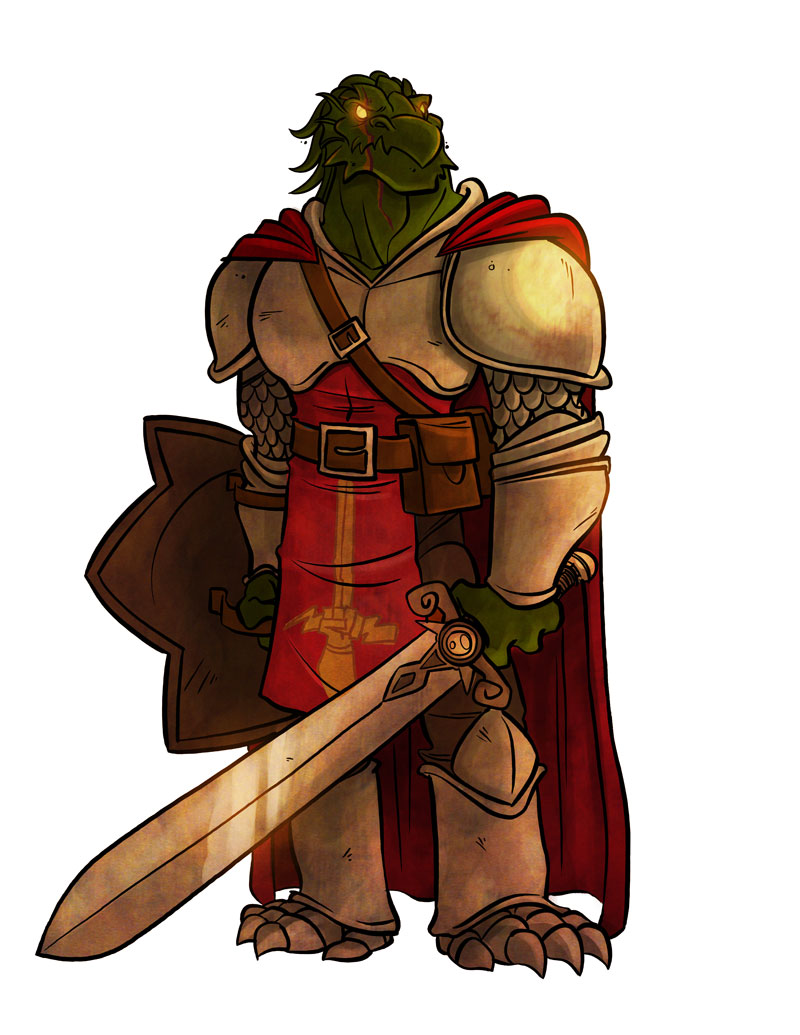
Dragonborn are scaly, quasi-reptilian humanoids that claim descent from dragons-- a claim corroborated by the fact that they are found in the same colors (though usually more muted, earthy shades) as the various known species of dragon, and by the fact that many of them share a breath weapon with the dragons they closely resemble. Dragonborn tend to be about six feet tall and weigh over 200 lbs. Dragonborn are often very proud, serious and humorless, but exude a predatory confidence.
Restrictions: Dragonborn use 8-sided dice (d8) to determine their hit points. They may advance to a maximum of the 11th level of experience. Dragonborn may use any type of weapon or armor and may use shields. A Dragonborn character must have a minimum Strength of 9 and a minimum Charisma of 7.
Special Abilities: Dragonborn are covered in thick but flexible scales that give them a -2(+2) bonus to their AC. All dragonborn have a breath weapon similar to that of a dragon, usable three times per day but no more than once per hour, which deals 1d4 points of damage per level, to a maximum of 5d4 damage, along either a cone 40 feet long and 20 feet wide at its far end (if fire or cold), a 20-foot diameter cloud (if toxic gas), or a 60-foot line (if lightning or acid). A successful saving throw against Dragon Breath reduces the damage by half. A dragonborn gains a +2 bonus to any saving throws against damage of the same type as their breath weapon. Dragonborn speak the languages of dragons, kobolds, orcs, and goblins.
And as a monster...
Dragonborn
AC: 4 (15)
HD: 1+1
Move: 120' (40')
Attacks: 1 weapon plus breath weapon
Damage: 1d8 or by weapon
# Appearing: 1d4 (2d10)
Save as: F1
Morale: 9
Treasure Type: E
Alignment: Neutral
Dragonborn are reptilian humanoids that bear a resemblance to dragons. Like dragons, they have a breath attack (See above for details). All closely-related dragonborn will have the same type of breath attack. If a group of 15 or more Dragonborn appear, one will be a leader of level 2-9 (1d8+1). To check for magic items the leader may own, multiply the leader's level by 5. The result is the percentage chance for that leader to have a magic item from any subtable. Roll separately for every subtable. So long as the leader is alive morale is 11 rather than 9.
UPDATE: Here it is as a one-page, easy-to-print PDF if you want one.
Dragonborn
Art by Gabe
Prime requisite: STR
Requirements: STR 9, CHA 7
Hit Dice: 1d8
Attack as: Fighter
Save as: Fighter
Advance as: Magic-Users
Maximum level: 11
Dragonborn are scaly, quasi-reptilian humanoids that claim descent from dragons-- a claim corroborated by the fact that they are found in the same colors (though usually more muted, earthy shades) as the various known species of dragon, and by the fact that many of them share a breath weapon with the dragons they closely resemble. Dragonborn tend to be about six feet tall and weigh over 200 lbs. Dragonborn are often very proud, serious and humorless, but exude a predatory confidence.
Restrictions: Dragonborn use 8-sided dice (d8) to determine their hit points. They may advance to a maximum of the 11th level of experience. Dragonborn may use any type of weapon or armor and may use shields. A Dragonborn character must have a minimum Strength of 9 and a minimum Charisma of 7.
Special Abilities: Dragonborn are covered in thick but flexible scales that give them a -2(+2) bonus to their AC. All dragonborn have a breath weapon similar to that of a dragon, usable three times per day but no more than once per hour, which deals 1d4 points of damage per level, to a maximum of 5d4 damage, along either a cone 40 feet long and 20 feet wide at its far end (if fire or cold), a 20-foot diameter cloud (if toxic gas), or a 60-foot line (if lightning or acid). A successful saving throw against Dragon Breath reduces the damage by half. A dragonborn gains a +2 bonus to any saving throws against damage of the same type as their breath weapon. Dragonborn speak the languages of dragons, kobolds, orcs, and goblins.
And as a monster...
Dragonborn
AC: 4 (15)
HD: 1+1
Move: 120' (40')
Attacks: 1 weapon plus breath weapon
Damage: 1d8 or by weapon
# Appearing: 1d4 (2d10)
Save as: F1
Morale: 9
Treasure Type: E
Alignment: Neutral
Dragonborn are reptilian humanoids that bear a resemblance to dragons. Like dragons, they have a breath attack (See above for details). All closely-related dragonborn will have the same type of breath attack. If a group of 15 or more Dragonborn appear, one will be a leader of level 2-9 (1d8+1). To check for magic items the leader may own, multiply the leader's level by 5. The result is the percentage chance for that leader to have a magic item from any subtable. Roll separately for every subtable. So long as the leader is alive morale is 11 rather than 9.
Thursday, June 27, 2013
Clerical Orders of the Majestic Wilderlands (wip)
Of late, I've tended to favor the Wilderlands pantheon in my homebrews, instead of the 4e pantheon, which had previously been my go-to-- though don't get me wrong I don't mind using that and might even do so in the future. (I think I owe a bit of my fondness of it to the Raven Queen-- come-on, a non-evil death goddess with a raven motif? I was bound to imagine her as Neil Gaiman's Death, and thus to fall madly in love.)
To that end, and also because I like the idea of clerics being a little different for different gods, and because this is supported by ACKS's rules... well, here's some work on my part. Credit for the descriptions of the gods themselves goes to Rob Conley, from whom I cribbed them here, and I think ultimately to some combination of Bob Bledsaw, Robert E. Howard, and ancient people who actually worshiped about half of these bad boys.
Oh, and we should get this out of the way-- by default clerics IMC can always use spears, daggers, and crossbows in addition to the usual blunt fare-- I always thought the "no edged weapons because blood" thing was really, really stupid.
Clerics of Hamakhis use the following spells
Clerics of Mitra use the Bladedancer spell list.
Clerics of Nephthys use the following spell list:
Clerics of Ptah use the normal Cleric spell list, except replace Sticks to Snakes with Create Objects because Sticks to Snakes is too fucking biblical (unless you give it to...)
Clerics of Set use the following spell list:
Clerics of Thoth use the following Spell List:
Clerics of Thor use the following spell list.
New Spells:
Please don't hesitate to bug me if my math is off or anything like that, or if you have a cool idea for other gods or pantheons or whatever to do.
To that end, and also because I like the idea of clerics being a little different for different gods, and because this is supported by ACKS's rules... well, here's some work on my part. Credit for the descriptions of the gods themselves goes to Rob Conley, from whom I cribbed them here, and I think ultimately to some combination of Bob Bledsaw, Robert E. Howard, and ancient people who actually worshiped about half of these bad boys.
Oh, and we should get this out of the way-- by default clerics IMC can always use spears, daggers, and crossbows in addition to the usual blunt fare-- I always thought the "no edged weapons because blood" thing was really, really stupid.
In place of Turn Undead Dannu's clerics have the following powers:DANNU (DAN-NU) - The Mother of Mercy, Lady of the Green Earth, the Hearth Mother
Dannu is the goddess of mercy, love, home, and fields. Dannu is worshipped by peasants thourghout the Majestic Wilderlands. The church of Dannu works to bring aid and relief to the peasant when they suffer. The church of Dannu has special relationship with the church of Mitra . Together the two churches work to bring justice and peace to the Wilderlands. Also the church of Silvanus and Dannu cooperate on many matters.
SYMBOL: A Sheaf of Wheat on a Green Circle
Purify Food and Drink as the spell of the same name at will, taking 1 turn to take effect.
Blessed Feast: Once per day a cleric of Dannu can imbue a meal for a number of people equal to her level with her blessing. All who partake of the meal are affected as if by a Bless spell.Clerics of Dannu use the following spell list:
| First Level Divine Spells | Second Level Divine Spells | Third Level Divine Spells | |
| 1 | Command Word | Bless* | Continual Light* |
| 2 | Cure Light Wounds* | Calm Emotions | Cure Blindness |
| 3 | Detect Evil | Charm Animal | Cure Disease* |
| 4 | Detect Magic | Delay Poison | Detect Curse |
| 5 | Fellowship* | Divine Grace | Glyph of Warding |
| 6 | Light* | Find Traps | Growth of Animals |
| 7 | Protection from Evil | Holy Chant | Locate Object |
| 8 | Remove Fear* | Resist Fire | Prayer |
| 9 | Resist Cold | Silence, 15' Radius | Protection fr. Normal Missiles |
| 10 | Sanctuary | Speak With Animals | Remove Curse* |
| Fourth Level Divine Spells | Fifth Level Divine Spells | |
| 1 | Create Water | Atonement |
| 2 | Cure Serious Wounds |
Command Plants
|
| 3 | Dispel Magic |
Commune
|
| 4 | Divination | Create Food |
| 5 | Fate | Dispel Evil |
| 6 | Growth of Plants | Insect Plague |
| 7 | Neutralize Poison | Quest* |
| 8 | Protection From Evil (sustained) | Restore Life and Limb* |
| 9 | Speak with Plants | Strength of Mind* |
| 10 | Vigor | Summon Weather |
Depending on their sect, some clerics of Hamakhis command undead instead of turning them.HAMAKHIS (HA-MA-KISS) - The Deathlord, Lord of Undeath, The Final Judge
He is the god of death and judgement. All who die come to Hamakhis were they judged; those who fail dwell forever in the City of Bones and the rest proceed to their god. Hamakhis is also able to grant to undeath to his followers.
Hamakhis has two types of sects; the first believing that if one make the proper sacrifices to Hamakhis and glorify his name, they will be granted the state of undeath, the second preachs about Hamakhis the Final Judge and warns people to be ready for him.
SYMBOL: A White Skull
Clerics of Hamakhis use the following spells
| First Level Divine Spells | Second Level Divine Spells | Third Level Divine Spells | |
| 1 | Cause Fear* | Augury | Continual Darkness |
| 2 | Command Word | Bless* | Cure Blindness |
| 3 | Cure Light Wounds |
Choking Grip
|
Cure Disease |
| 4 | Deathwatch | Deathknell | Detect Invisible |
| 5 | Detect Evil |
Delay Poison
|
ESP |
| 6 | Detect Magic | Find Traps | Feign Death |
| 7 | Detect Undead | Hold Person | Glyph of Warding |
| 8 | Light* | Obscuring Cloud | Necromantic Potence |
| 9 | Protection From Evil* | Silence, 15' Radius | Remove Curse |
| 10 | Read Languages | Sleep | Speak With Dead |
| Fourth Level Divine Spells | Fifth Level Divine Spells | |
| 1 | Cure Serious Wounds* | Atonement |
| 2 | Death Ward |
Commune
|
| 3 | Dispel Magic |
Cone of Paralysis
|
| 4 | Divination |
Control Undead
|
| 5 | Dismember |
Fear
|
| 6 | Enervate |
Finger of Death
|
| 7 | Infravision | Insect Plague |
| 8 | Neutralize Poison* | Quest* |
| 9 | Protection fr. Evil, Sustained* | Strength of Mind |
| 10 | Smite Undead* | True Seeing |
Kali's holy orders also include plenty of assassins and mystics. Some of her clerics fight as Bladedancers instead. In place of Turn Undead, Kali's clerics have the following powers:KALI (KAA-LEE) - The Black Mother, The Death Crone, Lady of Illusions
Kali is the goddess of murder, hatred, and lust. Her goals directly conflict with those of the goddess Dannu. She revels in death and destruction. She sunders man and wife, takes the newborn from their mother, and brings famine and plague to the Wilderlands. Her followers are secreted in obsure caves, little alleys, and hidden valleys. The Claws of Kali are the most feared killers in the Majestic Wilderlands. The Claws support the main temples of Kali. Also in many lands where temples are not able to be estabilshed, Kali is served by her Blood Childern, the Vampires and Werewolves. The Power of Blood makes them fearsome creatures of the night.
SYMBOL: The Kris Knife (Wavy Bladed Dagger)
Bloodlust: Clerics of Kali gain the Zaharan Ruinguard's Death Healing ability for free.
Incite Rage: Once per day, clerics of Kali can cause a creature to enter a berserker rage by touch. The rage lasts a number of rounds equal to the cleric's level.Clerics of Kali receive the following spells
| First Level Divine Spells | Second Level Divine Spells | Third Level Divine Spells | |
| 1 | Cause Fear | Bane | Alter Self |
| 2 | Command Word |
Choking Grip
|
Cause Disease |
| 3 | Detect Good | Deathknell | Charm Person |
| 4 | Detect Magic |
Enthrall
|
Curse |
| 5 | Hemorrhage |
Hold Person
|
Feign Death |
| 6 |
Light*
|
Holy Chant
|
Glyph of Warding |
| 7 | Protection from Good |
Resist Fire
|
Invisibility
|
| 8 | Sharpness | Righteous Wrath | Invulnerability to Good |
| 9 | Trance | Spiritual Weapon | Levitate |
| 10 | Wall of Smoke | Swift Sword | Striking |
| Fourth Level Divine Spells | Fifth Level Divine Spells | |
| 1 | Dismember |
Commune
|
| 2 | Dispel Magic |
Confusion
|
| 3 | Divination |
Fear
|
| 4 | Enervate |
Finger of Death
|
| 5 | Inflict Serious Wounds |
Flame Strike
|
| 6 | Nondetection |
Insect Plague
|
| 7 | Poison |
Phantasmal Killer
|
| 8 | Protection fr. Good, Sustained |
Quest
|
| 9 | Raise Dead | Scry |
| 10 | Vigor | Sword of Fire |
Mitra's Clerics tend to be female slightly more often than not. Some have Turn Undead, but others have the Paladin's Aura of Protection and Lay on Hands abilities instead. Many clerics of Mitra fight as bladedancers. Her holy orders are the most likely to produce paladins.
MITRA (MI-TRA) -The Red Maiden, The Lady of the White Hand, Lady of Paladins
Mitra is the goddess of justice, war, and paladins. Mitra defends the helpless, and protects the weak from those who desire to prey on them. There is great enmity between the church of Mitra and the church of Set. The Church of Mitra has a special relationship with the church of Dannu. Together the three churches work to bring justice to the Wilderlands.
SYMBOL: The White Hand on a Red Circle, The White Lion
Clerics of Mitra use the Bladedancer spell list.
Instead of Turn Undead, Clerics of Nephthys have the Elven Enchanter's Glamorous Aura and gain the Magical Music proficiency for free.NEPHTHYS (Nep-thee-is) - The Bargainer, The Golden Lady, The Queen of Opalescence
She is the goddess of wealth and pleasure; she is widely worshipped thorughout the Majestic WIlderlands by merchants. Nephthy's followers believe that if one honors the Bargainer and indulges her pleasure, one will succed in commerce. Her worship invariably involves orgies and sexual rites.
SYMBOL: Three Golden Coins
Clerics of Nephthys use the following spell list:
| First Level Divine Spells | Second Level Divine Spells | Third Level Divine Spells | |
| 1 | Command Word | Bless* | Alter Self |
| 2 | Cure Light Wounds* |
Enthrall
|
Charm Person |
| 3 | Detect Evil* |
Locate Object
|
Continual Light* |
| 4 | Detect Magic |
Hold Person
|
Cure Blindness |
| 5 |
Faerie Father
|
Holy Chant
|
Cure Disease* |
| 6 |
Light*
|
Magic Mouth
|
Glyph of Warding |
| 7 |
Protection from Evil*
|
Resist Fire
|
Hypnotic Pattern
|
| 8 | Purify Food and Water |
Righteous Wrath
|
Phantasmal Force
|
| 9 | Remove Fear* |
Silence, 15' Radius
|
Prayer
|
| 10 | Salving Rest | Snake Charm |
Remove Curse*
|
| Fourth Level Divine Spells | Fifth Level Divine Spells | |
| 1 | Clairvoyance |
Charm Monster
|
| 2 | Create Water |
Command Person
|
| 3 | Cure Serious Wounds* |
Commune
|
| 4 | Dispel Magic |
Create Food
|
| 5 | Divination |
Enchanted Container
|
| 6 | Find Treasure |
Flame Strike
|
| 7 | Neutralize Poison* |
Quest*
|
| 8 | Protection fr. Evil, sustained |
Restore Life and Limb*
|
| 9 | Vigor |
Scry
|
| 10 | Tongues |
Spectral Force
|
In addition to human Clerics, Ptah's faithful include the majority of Dwarven Craftpriests. Ptah hates undead and sees them as a perversion of the life he imbued mortals with, so his priests get Turn Undead as usual.PTAH (TAH) - The Craftsman, The Star Lord, The Father of Multitudes
Ptah is the god of crafts, artifice, and of creation. He is revered by the Dwarves. He is claimed to be the eldest of the gods and the first to come to the Wilderlands. Ptah created the creatures of the earth and all of the childern races. He etabilshed the First Coveant by which the Childern Races were taught and brought to glory. Ptah also estabilshed the Second Coveant by which the surviving gods of the Uttermost War agreeded to rule the Wilderlands by.
SYMBOL: A silver chime with a golden hammer.
Clerics of Ptah use the normal Cleric spell list, except replace Sticks to Snakes with Create Objects because Sticks to Snakes is too fucking biblical (unless you give it to...)
Much as Mitra is the patron of most paladins, Set is the patron of most anti-paladins, especially the fearsome Myrmidons. Some of Set's priests fight as Shamans. Instead of Turn Undead, priests of Set get a Totem Animal and Shapechange as a Shaman does, however they must choose either a Cobra or a Python as their totem.SET (SET) - The Serpant Lord, The Dragon, the Night Hunter
Set is the god of war, night, and evil. He is the conquerer, the emperor, and the dragon. He teaches the one must strive for honor and glory. He also teaches that one must obey those above him and expect those below to obey.
SYMBOL: A serpant head on a black circle
Clerics of Set use the following spell list:
| First Level Divine Spells | Second Level Divine Spells | Third Level Divine Spells | |
| 1 | Cause Fear | Augury | Cause Disease |
| 2 | Command Word |
Bane
|
Charm Person |
| 3 | Detect Good* |
Chameleon
|
ESP |
| 4 | Detect Magic |
Choking Grip
|
Glyph of Warding |
| 5 | Detect Poison |
Enthrall
|
Hypnotic Pattern |
| 6 | Inflict Light Wounds |
Hold Person
|
Invisibility |
| 7 |
Light*
|
Silence, 15' Radius
|
Phantasmal Force |
| 8 |
Protection from Good
|
Silent Step
|
Remove Curse* |
| 9 | Spider Climb |
Snake Charm
|
Speak with Dead |
| 10 | Trance | Spiritual Weapon |
Striking
|
| Fourth Level Divine Spells | Fifth Level Divine Spells | |
| 1 | Chimerical Force |
Call Dragon
|
| 2 | Dismember |
Cone of Paralysis
|
| 3 | Dispel Magic |
Fear
|
| 4 | Enervate |
Finger of Death
|
| 5 | Inflict Serious Wounds |
Insect Plague
|
| 6 | Infravision |
Polymorph Other
|
| 7 | Poison |
Polymorph Self
|
| 8 | Protection from Good, sustained |
Quest
|
| 9 | Sticks to Snakes |
Spectral Force
|
| 10 | Telepathy |
Strength of Mind
|
Silvanus's priests are by-the book Shamans, much as Ptah's are (virtually) by-the-book Clerics and many of Mitra's are by-the-book Bladedancers.SILVANUS (SIL-VAN-US) - The Forest King, The Dreamlord
Silvanus is the god of dreams, magic, and the forest. Silvanus is especially revered by the Elves. His worship involves a lot of mysticism, simple but yet complex rituals, and magic. Among Humans his followers are known as Druids and the Rangers take Silvanus as their patron. Silvanus's followers work a lot with the church of Dannu.
SYMBOL: A Azure (Blue) Bowl
Thoth has a great many orders of Mystics. In place of turning undead, Clerics of Thoth gain the Bard's Loremastery Ability and the Mystic's Probability Trance ability.THOTH (THAWTH) - The Immortal Sage, The Bearer of the Lantern
Thoth is the god of knowledge. He is charged by Ptah with the keeping of the Second Coveant and the recording of all what transpire in the Wilderlands. His followers mainly follow the monastic life and collect books of lore. The church of Thoth also has an order that produces many fine jesters that entertain the courts of the Wilderlands.
SYMBOL: Lantern
Clerics of Thoth use the following Spell List:
|
|
First Level Divine Spells |
Second Level Divine Spells |
Third Level Divine Spells |
|
1 |
Command Word |
Augury |
Continual Light* |
|
2 |
Cure Light Wounds |
Bless*
|
Cure Blindness |
|
3 |
Detect Evil* |
Calm Emotions |
Cure Disease* |
|
4 |
Detect Magic |
Delay Poison
|
Detect Curse |
|
5 |
Light* |
Find Traps
|
Detect Invisible |
|
6 |
Predict Weather
|
Hold Person
|
Detect Secret Doors |
|
7 |
Read Languages
|
Holy Chant
|
ESP |
|
8 |
Sanctuary
|
Produce Fire
|
Locate Object |
|
9 |
Trance |
Silence 15' Radius
|
Remove Curse* |
|
10 |
Wall of Smoke |
Zone of Truth
|
Speak With Dead |
|
|
Fourth Level Divine Spells |
Fifth Level Divine Spells |
|
1 |
Clairaudience |
Command Person
|
|
2 |
Clairvoyance |
Commune
|
|
3 |
Create Water |
Create Food
|
|
4 |
Cure Serious Wounds* |
Feeblemind
|
|
5 |
Divination |
Find Treasure
|
|
6 |
Fate |
Quest*
|
|
7 |
Infravision |
Restore Life and Limb
|
|
8 |
Neutralize Poison* |
Scry
|
|
9 |
Telepathy |
Strength of Mind*
|
|
10 |
Tongues* |
True Seeing
|
Besidrs Clerics, Thor also produces plenty of Paladins and a few Dwarven Craftpriests. In place of Turn Undead, Thor's Clerics gain the benefits of the Goblin-slaying proficiency for free and the ability to Inspire Courage as a bard.THOR - The Lord of Icy Winds, Thunderer of the Gods.
Thor is the god of the wind, thunder, and war. He is the ultimate warrior, and the best at battle. His followers live for battle, and continually strive to improve their skills and do great deeds. They believe that to die in battle is the only way to die properly.
SYMBOL: Hammer
Clerics of Thor use the following spell list.
|
|
First Level Divine Spells |
Second Level Divine Spells |
Third Level Divine Spells |
|
1 |
Cure Light Wounds* |
Bless* |
Call Lightning |
|
2 |
Detect Evil* |
Divine Grace
|
Continual Light* |
|
3 |
Detect Magic |
Hold Person
|
Cure Blindness |
|
4 |
Fellowship |
Obscuring Cloud
|
Cure Disease |
|
5 |
Light* |
Ogre Power
|
Eyes of the Eagle |
|
6 |
Predict Weather
|
Resist Fire
|
Glyph of Warding |
|
7 |
Protection from Evil*
|
Righteous Wrath
|
Protection fr. Normal Missiles |
|
8 |
Remove Fear*
|
Spiritual Weapon
|
Remove Curse* |
|
9 |
Resist Cold
|
Summon Hero
|
Striking |
|
10 |
Summon Berserkers
|
Swift Sword
|
Summon Winged Steed |
|
|
Fourth Level Divine Spells |
Fifth Level Divine Spells |
|
1 |
Create Water |
Atonement
|
|
2 |
Cure Serious Wounds* |
Control Winds
|
|
3 |
Dispel Magic |
Create Food*
|
|
4 |
Fly |
Dispel Evil*
|
|
5 |
Giant Strength |
Growth
|
|
6 |
Gust of Wind |
Hold Monster
|
|
7 |
Hold Giant |
Quest*
|
|
8 |
Neutralize Poison* |
Restore Life and Limb*
|
|
9 |
Protection fr. Evil, Sustained |
Summon Weather
|
|
10 |
Vigor |
Thunder Strike |
New Spells:
Calm Emotions Range: 60 ft
Divine 2 (Cleric) Duration: Concentration, up to 1 round per level
This spell calms emotionally-agitated creatures. You have no control over the emotions of the creatures within the area of effect, but being calmed stops hostile creatures from attacking or joyous ones from reveling. Any aggressive action against or damage dealt to a calmed creature immediately breaks the spell on all calmed creatures.
This spell automatically suppresses (but does not dispel) any bonuses granted by spells such as bless, as well as negating such effects as a bard’s ability to inspire courage or a berserker rage. It also suppresses any magical fear and the effects of a Confusion spell. While the spell lasts, a suppressed spell or effect has no effect. When the calm emotions spell ends, the original spell or effect takes hold of the creature again, provided that its duration has not expired in the meantime.
Deathwatch Range: 60 ft
Divine 1 Duration: Concentration
This spell allows you to tell by sight if a creature is alive, near death (alive with fewer hit points than the number of HD it has), dead, or neither alive nor dead (such as a construct or automaton). This spell sees through any spell or ability that allows a creature to feign death.
Deathknell Range: 60 ft
Divine 2 Duration: Instantaneous
This spell, with the sound of an iron bell, causes a single creature in range that is at or below 0 HP but not yet dead to save vs. death or immediately lose its grip on life. If it dies, you regain hit points equal to its level or the number of HD it had.
Hemmorrhage Range: 30 ft
Divine 1 Duration: Special
This spell causes one creature to begin bleeding profusely. Unless the affected creature makes a succesful saving throw vs. death, the bleeding will be so severe and painful that it cannot act, and loses 1d3 HP per round. A healing spell restores the damage but does not immediately stop the bleeding. The target of the spell receives a new saving throw each round. The spell lasts until either the targeted creature makes a saving throw or the caster stops concentrating.
Hold Giant Range: 180'
Divine 4 Duration: 2d8 turns
This spell functions like hold person, except that it affects any giant humanoid of larger than ogre size that fails its save versus Paralysis.
Invulnerability to Good Range: self
Divine 3 Duration: 1 turn
This spell is essentially the reversed version of Invulnerability to Evil, and as such, it protects the caster from normal, non-magical attacks by “good" creatures. Magic or silver weapons can harm the character, but any number of normal swords, arrows, clubs, or natural weapons wielded by an evil creature will be fended off.
Evil monsters which themselves can only be affected by silver or magical weapons can still harm the subject, and evil monsters with 5 HD or more are able to affect the subject through natural ferocity. For purposes of this spell, evil creatures include hostile creatures of an alignment other than the caster’s alignment, and inherently good creatures such as summoned creatures of Lawful alignment.
Thunder Strike Range: 60'
Divine 5 Duration: instantaneous
A thunder strike produces a vertical column of divine lightning 30' high and 10' in diameter that roars downward on a target. The spell deals 6d8 points of damage. A successful saving throw versus Spells reduces the damage to 3d8. The only way this spell differs from Flame Strike is that it is Air-elemental rather than Fire, because Thor is a thunder-god.
Please don't hesitate to bug me if my math is off or anything like that, or if you have a cool idea for other gods or pantheons or whatever to do.
Subscribe to:
Posts (Atom)