Okay so an anonymous commenter remarked that the tiefling seemed a little powerful. Accordingly I've decided to run it through the ACKS Player's Companion class construction system, which I think is probably the best resource for that kind of thing. (Those of you who aren't familiar with it, just nod and smile). This is what I uncovered:
First of all let's say that the Tiefling racial abilities (immunity to fear, three thief abilities, and magical ability) are roughly equivalent to that of an Elf. My rationale for that: a hypothetical value of Thievery Value 1.5 (4 skills, assuming we trade off one for the fear immunity) would be 300, since Thievery Value 1 is 200 with three skills and Thievery Value 2 is 400 with five skills. Plus Arcane Value 4 (2500 and full caster progression) brings Tiefling value 4 up to 2800.
It has a d6 HD value, so that's another 500 for an XP base of 3200. Add a fighting value 2 (equivalent to the fighter class, 1000 XP base) and you walk away with an XP value of 4200 from first to second level.
Okay, so it's a little more powerful than an Elf at this point. To that end, let's tweak it a little bit and bring it down to a hypothetical Tiefling 3 (the equivalent of an Arcane value of 3), giving it a spellcasting ability of a mage equal to 2/3rds its level. So its arcane value adds 1875 to the XP base instead of 2500. 1875+300=2175, 2175+500=2675, 2675+1000=3675, in other words very slightly less than that of an Elf. For convenience's sake let's suppose that I want to try to get a little closer to an elf's progression, so let's bump up the Thievery Value all the way to 2 and give them another custom power, something like the Zaharan's ancient pacts. 1875+400=2275, 2275+500=2775, 2775+1000=3775... and honestly I think that's close enough for me. So the Tiefling will be revised tonight.
Sunday, August 25, 2013

Saturday, August 24, 2013
New-school race-as-classes part the third: Tieflings
I mean, I guess Tieflings aren't really that new school given they were in 2e, but 4e took them in a particular direction that I quite liked. I'm not 100% happy with it yet, so if you think there's something that needs changing I'm not above putting out a second draft. UPDATED 8/26: Make that a third draft, thanks to Anonymous Commenter #1.
Tiefling

Requirements: INT 9
Hit Dice: 1d6
Attack as: Fighter
Save as: Elf
Advance as: Elf
Maximum level: 10
Tieflings are the descendants of nobles of a decadent human empire that entered into a series of alliances (both military and marital) with the forces of Chaos. They resemble devilish humanoids with an aristocratic bearing, and often have reddish, grey, or stark white skin, horns, and tails. Some have cloven hooves for feet. In the Wilderlands, Tieflings are also known as Viridians and tend towards green skin instead. Tieflings tend to be about the same height (not counting their horns) and weight as humans.
Restrictions: Tieflings use 6-sided dice (d6) to determine their hit points. They may advance to a maximum of the 10th level of experience. Tieflings may use any type of weapon or armor and may use shields. A Tiefling character must have a minimum Intelligence of 9.
Special Abilities: Tieflings have infravision and can see 60 feet in the dark. They cast spells as Magic-Users or Elves of two thirds their level, as detailed on the chart below. Tieflings are immune to fear effects. While wearing leather armor or less, a tiefling may hide in shadows, move silently, and backstab as a thief of the same level. Inherently Chaotic monsters still often remember the old pacts made between them and the first Tieflings and so apply a +2 bonus to their reaction rolls and a -2 penalty to saving throws against any Charm spells the Tiefling uses against them.
Table: Tiefling spells by level
Tieflings:
AC: 5 (14)
HD: 1+1
Move: 120' (40')
Attacks: 1 weapon Damage: 1d8 or by weapon
# Appearing: 1d4 (2d12)
Save as: E1
Morale: 8
Treasure Type: E
Alignment: Neutral or Chaotic
Tieflings are handsome, devilish-looking humanoids. Each tiefling will have one first level spell (chosen at random) If a group of 15 or more Tieflings appear, one will be a leader of level 2-7 (1d6+1). To check for magic items the leader may own, multiply the leader's level by 5. The result is the percentage chance for that leader to have a magic item from any subtable. Roll separately for every subtable. So long as the leader is alive morale is 10 rather than 8.
Tiefling
Art
by Zaebrael (you have no idea how hard it is to find a female
tiefling in reasonable armor!)
Prime requisite: STR and INTRequirements: INT 9
Hit Dice: 1d6
Attack as: Fighter
Save as: Elf
Advance as: Elf
Maximum level: 10
Tieflings are the descendants of nobles of a decadent human empire that entered into a series of alliances (both military and marital) with the forces of Chaos. They resemble devilish humanoids with an aristocratic bearing, and often have reddish, grey, or stark white skin, horns, and tails. Some have cloven hooves for feet. In the Wilderlands, Tieflings are also known as Viridians and tend towards green skin instead. Tieflings tend to be about the same height (not counting their horns) and weight as humans.
Restrictions: Tieflings use 6-sided dice (d6) to determine their hit points. They may advance to a maximum of the 10th level of experience. Tieflings may use any type of weapon or armor and may use shields. A Tiefling character must have a minimum Intelligence of 9.
Special Abilities: Tieflings have infravision and can see 60 feet in the dark. They cast spells as Magic-Users or Elves of two thirds their level, as detailed on the chart below. Tieflings are immune to fear effects. While wearing leather armor or less, a tiefling may hide in shadows, move silently, and backstab as a thief of the same level. Inherently Chaotic monsters still often remember the old pacts made between them and the first Tieflings and so apply a +2 bonus to their reaction rolls and a -2 penalty to saving throws against any Charm spells the Tiefling uses against them.
Table: Tiefling spells by level
Character Level
|
1st level spells
|
2nd level spells
|
3rd level spells
|
4th level spells
|
1
|
1
|
-
|
-
|
-
|
2
|
1
|
-
|
-
|
-
|
3
|
2
|
-
|
-
|
-
|
4
|
2
|
1
|
-
|
-
|
5
|
2
|
1
|
-
|
-
|
6
|
2
|
2
|
-
|
-
|
7
|
2
|
2
|
1
|
-
|
8
|
2
|
2
|
1
|
-
|
9
|
2
|
2
|
2
|
-
|
10
|
3
|
2
|
2
|
1
|
Tieflings:
AC: 5 (14)
HD: 1+1
Move: 120' (40')
Attacks: 1 weapon Damage: 1d8 or by weapon
# Appearing: 1d4 (2d12)
Save as: E1
Morale: 8
Treasure Type: E
Alignment: Neutral or Chaotic
Tieflings are handsome, devilish-looking humanoids. Each tiefling will have one first level spell (chosen at random) If a group of 15 or more Tieflings appear, one will be a leader of level 2-7 (1d6+1). To check for magic items the leader may own, multiply the leader's level by 5. The result is the percentage chance for that leader to have a magic item from any subtable. Roll separately for every subtable. So long as the leader is alive morale is 10 rather than 8.
Thursday, August 22, 2013
New-school race as classes 2: The Warforged
This will probably be a three-part series, with the last part being a tiefling. I mean I know last time I said the ruinguard from ACKS, but... I dunno, I have some thoughts about de-ACKS-izing it at the least. (I like ACKS but I dunno, I'm having fun here.) Those three are my favorites.
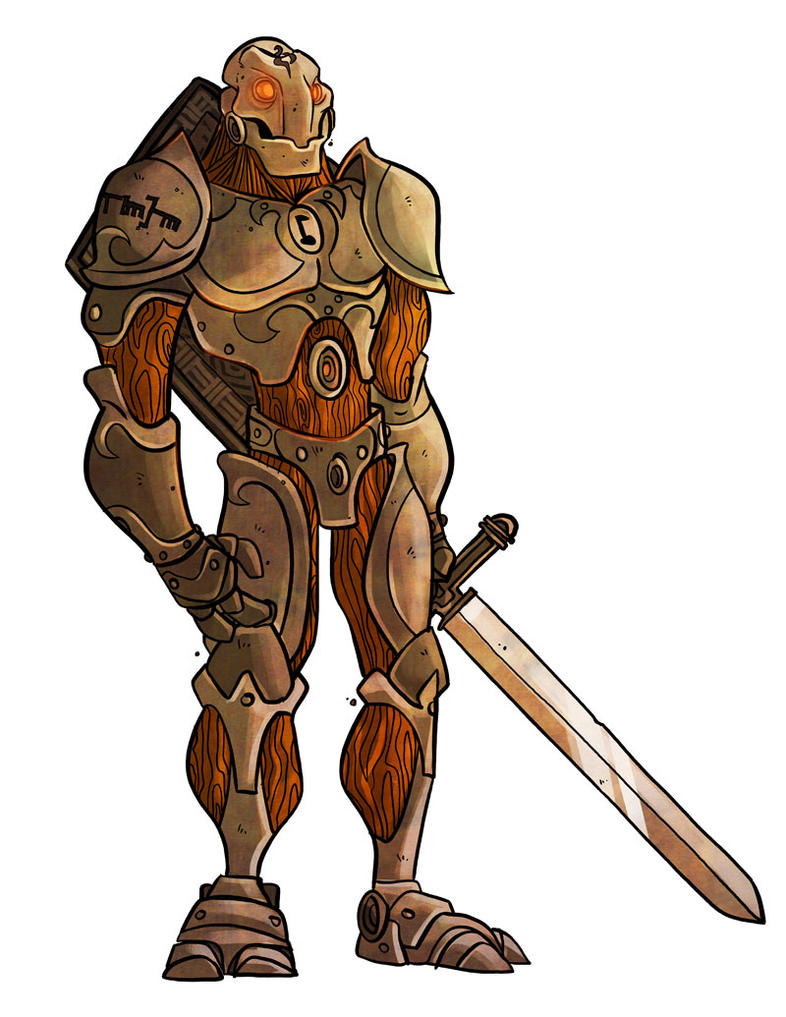
Warforged
Requirements: STR 9
Hit Dice: 1d8
Attack as: Fighter
Save as: Dwarf
Advance as: Dwarf
Maximum level: 10
Warforged are artificially-constructed beings made of a wooden, leather, and metal frame covered in armor-like steel plates, brought to life by means of magical and alchemical processes. They were created for a war that has since been consigned to history, and in the intervening years the secret of their creation has been lost. Despite their artificial appearances, warforged are self-aware and are often surprisingly "human" in their outlook. With the war they were built to fight gone, many turn to adventuring in hopes of finding a new purpose in life. Apart from the color of their eyes and a serial rune on the crown of their heads, all warforged look essentially alike to human eyes, though some paint identifying markings upon themselves. A warforged stands six feet tall and weighs 275 pounds. Although their bulky, somewhat angular appearance suggests masculinity to human eyes, most warforged are not strongly concerned with gender (though they have no problem going along with whatever gender others are comfortable assigning them).
Restrictions: Warforged use 8-sided dice (d8) to determine their hit points. They may advance to a maximum of the 10th level of experience. Warforged may use any type of weapon, and may use shields. Because they are already covered in armor-like plates of metal, any armor they wear must be specially-fitted and costs twice as much. Because of their wooden-and-metal construction, magical effects involving metal or wood affect them*. Warforged characters do not heal on their own and receive only half the normal effect of healing magic, but they can be repaired by any skilled armorer with access to a forge with one hour of work per point of damage suffered. A Warforged character must have a minimum Strength of 9.
Special Abilities: Warforged are covered in sturdy metal plating that grants them a -2(+2) bonus to their armor class. Although they have souls and are alive, warforged are immune to the effects of fatigue, disease, and poison, and have no need to eat, drink, sleep, or breathe (however poison gas such as the breath weapons of green dragons is still dangerous to them because it is corrosive to their organic components). Warforged do, however, have minds and souls and can thus be charmed, held, or raised from the dead like any other person.
Warforged
AC: 4 (15)
HD: 1+1
Move: 120' (40')
Attacks: 1 weapon
Damage: 1d8 or by weapon
# Appearing: 1d6 (2d10)
Save as: F1
Morale: 8
Treasure Type: B
Alignment: Neutral
Warforged are artificial people made primarily of leather, wood, and steel. They are immune to poison, disease, and sleep effects. If a group of 15 or more Warforged appear, one will be a leader of level 3-8 (1d6+2). To check for magic items the leader may own, multiply the leader's level by 5. The result is the percentage chance for that leader to have a magic item from any subtable except the Scroll and Wand/Staff/Rod subtables**. So long as the leader is alive, morale is 10 instead of 8.
*For instance, a rust monster may use their feelers to consume a warforged's plating and other metal components, dealing 2d6 damage per round and negating their armor bonus***. If you use Rules Cyclopedia-style Druids in your campaign, they always count as holding a metal object for purposes of Heat Metal, Turn Wood repels them on a failed save, and Metal to Wood reduces their AC bonus by 1***. Warp Wood only affects objects, and thus does not affect Warforged.
**If the leader would otherwise wear magical armor, then their plating is enchanted instead. A warforged may remove such plating in order to use it for theirself***.
***New plating costs as much as plate armor. A warforged may replace their plating in an hour with the help of a skilled armorer with access to a forge.
UPDATE: Edited for clarity
Warforged
Art
by Gabe
Prime requisite: STRRequirements: STR 9
Hit Dice: 1d8
Attack as: Fighter
Save as: Dwarf
Advance as: Dwarf
Maximum level: 10
Warforged are artificially-constructed beings made of a wooden, leather, and metal frame covered in armor-like steel plates, brought to life by means of magical and alchemical processes. They were created for a war that has since been consigned to history, and in the intervening years the secret of their creation has been lost. Despite their artificial appearances, warforged are self-aware and are often surprisingly "human" in their outlook. With the war they were built to fight gone, many turn to adventuring in hopes of finding a new purpose in life. Apart from the color of their eyes and a serial rune on the crown of their heads, all warforged look essentially alike to human eyes, though some paint identifying markings upon themselves. A warforged stands six feet tall and weighs 275 pounds. Although their bulky, somewhat angular appearance suggests masculinity to human eyes, most warforged are not strongly concerned with gender (though they have no problem going along with whatever gender others are comfortable assigning them).
Restrictions: Warforged use 8-sided dice (d8) to determine their hit points. They may advance to a maximum of the 10th level of experience. Warforged may use any type of weapon, and may use shields. Because they are already covered in armor-like plates of metal, any armor they wear must be specially-fitted and costs twice as much. Because of their wooden-and-metal construction, magical effects involving metal or wood affect them*. Warforged characters do not heal on their own and receive only half the normal effect of healing magic, but they can be repaired by any skilled armorer with access to a forge with one hour of work per point of damage suffered. A Warforged character must have a minimum Strength of 9.
Special Abilities: Warforged are covered in sturdy metal plating that grants them a -2(+2) bonus to their armor class. Although they have souls and are alive, warforged are immune to the effects of fatigue, disease, and poison, and have no need to eat, drink, sleep, or breathe (however poison gas such as the breath weapons of green dragons is still dangerous to them because it is corrosive to their organic components). Warforged do, however, have minds and souls and can thus be charmed, held, or raised from the dead like any other person.
Warforged
AC: 4 (15)
HD: 1+1
Move: 120' (40')
Attacks: 1 weapon
Damage: 1d8 or by weapon
# Appearing: 1d6 (2d10)
Save as: F1
Morale: 8
Treasure Type: B
Alignment: Neutral
Warforged are artificial people made primarily of leather, wood, and steel. They are immune to poison, disease, and sleep effects. If a group of 15 or more Warforged appear, one will be a leader of level 3-8 (1d6+2). To check for magic items the leader may own, multiply the leader's level by 5. The result is the percentage chance for that leader to have a magic item from any subtable except the Scroll and Wand/Staff/Rod subtables**. So long as the leader is alive, morale is 10 instead of 8.
*For instance, a rust monster may use their feelers to consume a warforged's plating and other metal components, dealing 2d6 damage per round and negating their armor bonus***. If you use Rules Cyclopedia-style Druids in your campaign, they always count as holding a metal object for purposes of Heat Metal, Turn Wood repels them on a failed save, and Metal to Wood reduces their AC bonus by 1***. Warp Wood only affects objects, and thus does not affect Warforged.
**If the leader would otherwise wear magical armor, then their plating is enchanted instead. A warforged may remove such plating in order to use it for theirself***.
***New plating costs as much as plate armor. A warforged may replace their plating in an hour with the help of a skilled armorer with access to a forge.
UPDATE: Edited for clarity
Tuesday, August 20, 2013
B/X class: I tell you, I tell you the Dragonborn comes (50th post wooo!)
Okay so I haven't thought this out 100%-- I was going to start by building this using the ACKS custom class guidelines, but I got impatient. As usual, honest criticism is the only way I'll learn. (For those of you playing at home, the ACKS Zaharan Ruinguard is the corresponding Tiefling class)
UPDATE: Here it is as a one-page, easy-to-print PDF if you want one.
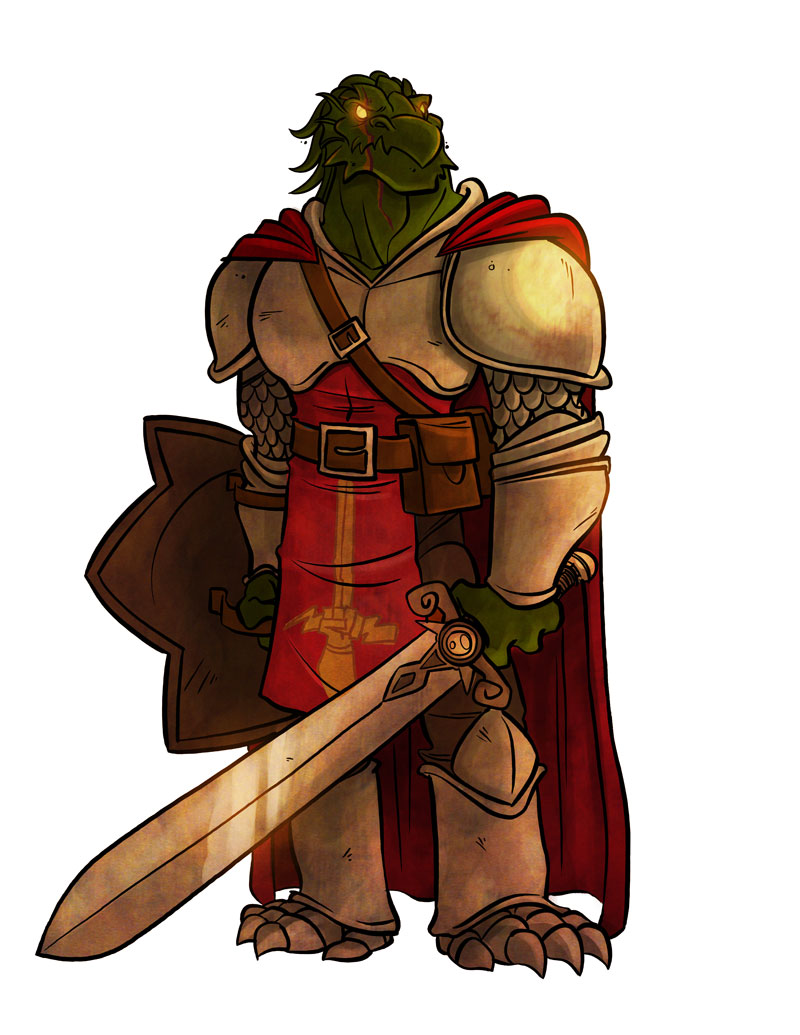
Dragonborn
Prime requisite: STR
Requirements: STR 9, CHA 7
Hit Dice: 1d8
Attack as: Fighter
Save as: Fighter
Advance as: Magic-Users
Maximum level: 11
Dragonborn are scaly, quasi-reptilian humanoids that claim descent from dragons-- a claim corroborated by the fact that they are found in the same colors (though usually more muted, earthy shades) as the various known species of dragon, and by the fact that many of them share a breath weapon with the dragons they closely resemble. Dragonborn tend to be about six feet tall and weigh over 200 lbs. Dragonborn are often very proud, serious and humorless, but exude a predatory confidence.
Restrictions: Dragonborn use 8-sided dice (d8) to determine their hit points. They may advance to a maximum of the 11th level of experience. Dragonborn may use any type of weapon or armor and may use shields. A Dragonborn character must have a minimum Strength of 9 and a minimum Charisma of 7.
Special Abilities: Dragonborn are covered in thick but flexible scales that give them a -2(+2) bonus to their AC. All dragonborn have a breath weapon similar to that of a dragon, usable three times per day but no more than once per hour, which deals 1d4 points of damage per level, to a maximum of 5d4 damage, along either a cone 40 feet long and 20 feet wide at its far end (if fire or cold), a 20-foot diameter cloud (if toxic gas), or a 60-foot line (if lightning or acid). A successful saving throw against Dragon Breath reduces the damage by half. A dragonborn gains a +2 bonus to any saving throws against damage of the same type as their breath weapon. Dragonborn speak the languages of dragons, kobolds, orcs, and goblins.
And as a monster...
Dragonborn
AC: 4 (15)
HD: 1+1
Move: 120' (40')
Attacks: 1 weapon plus breath weapon
Damage: 1d8 or by weapon
# Appearing: 1d4 (2d10)
Save as: F1
Morale: 9
Treasure Type: E
Alignment: Neutral
Dragonborn are reptilian humanoids that bear a resemblance to dragons. Like dragons, they have a breath attack (See above for details). All closely-related dragonborn will have the same type of breath attack. If a group of 15 or more Dragonborn appear, one will be a leader of level 2-9 (1d8+1). To check for magic items the leader may own, multiply the leader's level by 5. The result is the percentage chance for that leader to have a magic item from any subtable. Roll separately for every subtable. So long as the leader is alive morale is 11 rather than 9.
UPDATE: Here it is as a one-page, easy-to-print PDF if you want one.
Dragonborn
Art by Gabe
Prime requisite: STR
Requirements: STR 9, CHA 7
Hit Dice: 1d8
Attack as: Fighter
Save as: Fighter
Advance as: Magic-Users
Maximum level: 11
Dragonborn are scaly, quasi-reptilian humanoids that claim descent from dragons-- a claim corroborated by the fact that they are found in the same colors (though usually more muted, earthy shades) as the various known species of dragon, and by the fact that many of them share a breath weapon with the dragons they closely resemble. Dragonborn tend to be about six feet tall and weigh over 200 lbs. Dragonborn are often very proud, serious and humorless, but exude a predatory confidence.
Restrictions: Dragonborn use 8-sided dice (d8) to determine their hit points. They may advance to a maximum of the 11th level of experience. Dragonborn may use any type of weapon or armor and may use shields. A Dragonborn character must have a minimum Strength of 9 and a minimum Charisma of 7.
Special Abilities: Dragonborn are covered in thick but flexible scales that give them a -2(+2) bonus to their AC. All dragonborn have a breath weapon similar to that of a dragon, usable three times per day but no more than once per hour, which deals 1d4 points of damage per level, to a maximum of 5d4 damage, along either a cone 40 feet long and 20 feet wide at its far end (if fire or cold), a 20-foot diameter cloud (if toxic gas), or a 60-foot line (if lightning or acid). A successful saving throw against Dragon Breath reduces the damage by half. A dragonborn gains a +2 bonus to any saving throws against damage of the same type as their breath weapon. Dragonborn speak the languages of dragons, kobolds, orcs, and goblins.
And as a monster...
Dragonborn
AC: 4 (15)
HD: 1+1
Move: 120' (40')
Attacks: 1 weapon plus breath weapon
Damage: 1d8 or by weapon
# Appearing: 1d4 (2d10)
Save as: F1
Morale: 9
Treasure Type: E
Alignment: Neutral
Dragonborn are reptilian humanoids that bear a resemblance to dragons. Like dragons, they have a breath attack (See above for details). All closely-related dragonborn will have the same type of breath attack. If a group of 15 or more Dragonborn appear, one will be a leader of level 2-9 (1d8+1). To check for magic items the leader may own, multiply the leader's level by 5. The result is the percentage chance for that leader to have a magic item from any subtable. Roll separately for every subtable. So long as the leader is alive morale is 11 rather than 9.
Monday, August 19, 2013
Why is it I want a feat or proficiency system so much?
Why?
Is it that I want to have a way to mechanically differentiate two PCs of the same class?
Is it just that I was that impressed with ACKS's handling of familiars?
I kind of wish I could just let it go because it causes me more angst than I'd quite like.
Is it that I want to have a way to mechanically differentiate two PCs of the same class?
Is it just that I was that impressed with ACKS's handling of familiars?
I kind of wish I could just let it go because it causes me more angst than I'd quite like.
Saturday, August 17, 2013
Races for ACKS, part 1: The classics
I don't necessarily dislike race as class, and for sure ACKS has one of the best implementations of it. But you know, sometimes it isn't what I want. It's nothing wrong with me, and it's nothing wrong with ACKS, it's just good to have alternatives. So here's an alternative that I hope you'll find to your tastes. I'm not going to impose any class or level limitations on you because as far as I'm concerned, it's just not my place. Each race, in addition to their other benefits, has a list of proficiencies that they may treat as general or class proficiencies, whichever would be more beneficial at the moment.
I dunno, this is just an idea I dashed off over the course of an hour for the hell of it so I wouldn't mind hearing some feedback about it.
Dwarves: Dwarves gain the effects (and extra XP cost) of having a Dwarf value of 0 added to their class. Due to their short stature, dwarves may never use two-handed swords or longbows, regardless of their Fighting Value.
Dwarven Proficiencies: Armor Training*, Caving, Craft, Dungeon Bashing, Dwarven Brewing, Engineering, Goblin-Slaying, Illusion Resistance
Elves: Elves gain the effects (and extra XP cost) of having an Elf value of 0 added to their class.
Elvish Proficiencies: Alertness, Beast Friendship, Familiar, Naturalism, Passing Without Trace, Swashbuckling, Wakefulness, Weapon Finesse
Halflings: Due to their short stature, halflings may never use two-handed swords or longbows, regardless of their Fighting Value. Few halflings are experienced in adventuring, so even player character halflings begin without the Adventuring proficiency and must purchase it at the cost of a single proficiency.
A halfling value of 0 adds an XP cost of 150
At Halfling 0, all halflings gain the following powers:
Halfling Proficiencies: Adventuring, Alertness, Climbing, Combat Reflexes, Contortionism, Knowledge, Naturalism, Passing Without Trace, Skirmishing
- Like dwarves, halflings are Hardy people and reduce the target values for saves vs. blast/breath by 3 and the target values of all other saves by 4.
- Halflings are also strong-hearted and reduce the target values for saves against any sort of charm, fear, or mind-control effect by an additional 2 points.
- Halflings have Keen eyes and gain a +1 bonus to attack throws when using thrown or missile weapons.
- Outdoors, Halflings are tricky to spot, having the ability to seemingly disappear into woods and underbrush with a proficiency throw of 10+ on 1d20. In dungeons, a halfling who is motionless and quiet in cover can escape detection with a proficiency throw of 18+ on 1d20.
Humans: Humans do not incur any additional XP cost, and furthermore they begin with one additional proficiency due to their natural capacity for learning. Humans do not have any additional racial proficiencies.
I dunno, this is just an idea I dashed off over the course of an hour for the hell of it so I wouldn't mind hearing some feedback about it.
Thursday, August 15, 2013
New Monster: Concept Elemental
I hate the elemental planes.
There. I said it.
Now I don't hate them quite as much as the great wheel, but they still smack of a bunch of dumb symmetry to me. I just don't like it. The 4e Elemental Chaos is a little better, but even then it's not what I need.
So what are Elementals in my mind? Simple: animistic spirits. Nature kami. Which raises two questions. First, is there an elemental for the part of nature which is living? We'll come to that one in a moment. Second, is there an elemental for things that are part of the experience of sapient creatures? It is this which is the subject of my post. I found my answer in, of all places, Dungeon World, which just goes to prove that anything is a sourcebook if you have the right mindset. Here's the monster as DW presents it in its entirety.
Unlike other elementals, all concept elementals have a subtype reflecting just what state of being or thought that they are born of. A spellcaster can learn (typically via a quest or magical tome) how to summon a particular subtype of elemental. In this case, if the proper environment is present, the summoning will always bring forth the desired subtype, but otherwise the kind of concept elemental called upon will be completely random. A spellcaster can learn how to summon a number of subtypes equal to 1/2 his level.
Unless otherwise indicated, any spell-like abilities are treated as being cast by a spellcaster with a level equal to the elemental’s Hit Dice. Some spell effects are from the Advanced Edition Companion (in bold) others are from the ACKS Player's Companion (underlined). In parentheses will be listed the circumstances in which a creature takes extra damage for them
There. I said it.
Now I don't hate them quite as much as the great wheel, but they still smack of a bunch of dumb symmetry to me. I just don't like it. The 4e Elemental Chaos is a little better, but even then it's not what I need.
So what are Elementals in my mind? Simple: animistic spirits. Nature kami. Which raises two questions. First, is there an elemental for the part of nature which is living? We'll come to that one in a moment. Second, is there an elemental for things that are part of the experience of sapient creatures? It is this which is the subject of my post. I found my answer in, of all places, Dungeon World, which just goes to prove that anything is a sourcebook if you have the right mindset. Here's the monster as DW presents it in its entirety.
So here's my attempt to give you the Concept Elemental. I will include a dozen subtypes as examples, following in the manner of Dyson.Concept Elemental Solitary, Devious, Planar, Amorphous
Special Qualities: Ideal formThe planes are not as literal as our world. Clothed in the elemental chaos are places of stranger stuff than air and water. Here, rivers of time crash upon shores of crystal fear. Bleak storms of nightmare roil and churn in a laughter-bright sky. Sometimes, the spirits of these places can be lured into our world, though they are infinitely more unpredictable and strange than mere fire or earth might be. Easier to make mistakes, too—one might try calling up a wealth elemental and be surprised to find a murder elemental instead. Instinct: To perfect its concept
- Demonstrate its concept in its purest form
- Lesser Elemental (Summoned by Staff) – 8 HD, AC 2, 1d8 damage
- Greater Elemental (Summoned by Devices) – 12 HD, AC 0, 2d8 damage
- True Elemental (Summoned by Spells) – 16 HD, AC -2, 3d8 damage
- Legendary Elemental (Summoned by Ritual) – 20 HD, AC -4, 4d8 damage
Unlike other elementals, all concept elementals have a subtype reflecting just what state of being or thought that they are born of. A spellcaster can learn (typically via a quest or magical tome) how to summon a particular subtype of elemental. In this case, if the proper environment is present, the summoning will always bring forth the desired subtype, but otherwise the kind of concept elemental called upon will be completely random. A spellcaster can learn how to summon a number of subtypes equal to 1/2 his level.
Unless otherwise indicated, any spell-like abilities are treated as being cast by a spellcaster with a level equal to the elemental’s Hit Dice. Some spell effects are from the Advanced Edition Companion (in bold) others are from the ACKS Player's Companion (underlined). In parentheses will be listed the circumstances in which a creature takes extra damage for them
- Wealth: Create objects as an Efreet (Carrying more than 100 GP/level in money, precious metals, or gems on their person)
- Murder: Death attack after three rounds of study, target must save vs. death. (Creatures that have killed in cold blood or for selfish reasons)
- Dream: Hallucinatory Terrain, Phantasmal Forces, or Sleep 1/round. (Creatures that are unconscious or asleep)
- Terror: Fear or Phantasmal Forces 1/round (creatures that are afraid, whether magically or because they failed a morale check)
- Peace: Sanctuary 1/round (Creatures who have made an attack in the last turn)
- War: Weapons used against it may stick to it, as an Iron Living Statue. (creatures wielding weapons)
- Madness: Attacks cause Confusion (Creatures that are Confused, charmed, or under the effects of an illusion, or are actually insane)
- Truth: Dispel illusions 1/round (Creatures that have broken their word in the last year)
- Time: Attack randomly ages or de-ages target 1d10 years (Creatures that have been outside of or traveled in time-- or creatures that experience time at all if you want to be a killer DM about it)
- Size: Attack randomly increases (as Growth) or decreases size (as a potion of dimunition)
- Love: Charm Person or Charm Monster 1/round (creatures that are charmed or in love)
- Community: Allied creatures within 50' need never make morale checks and are immune to fear (People who are not members of the community it represents)
Subscribe to:
Posts (Atom)